
Table of Contents
With the rapid development of Industry 4.0, smart manufacturing and digital factories, robotic loading and unloading has become an important component of automation upgrades in the metal processing industry. Whether in laser cutting, CNC bending, punching, shearing machines, rolling machines, welding, or automated production lines, robotic loading and unloading plays an increasingly important role.
Compared to traditional manual loading and unloading, robots can achieve automatic gripping, precise positioning, continuous operation, intelligent changeover, and production data interconnection. This not only improves production efficiency but also reduces labor costs and safety risks, providing a solid foundation for enterprises to build flexible, intelligent, and efficient production.
1. Introduction To Robotic Loading And Unloading Systems
Robotic loading and unloading refers to the use of industrial robots or automated robotic arms, in conjunction with grippers, suction cups, hand grippers, vision recognition systems, positioning devices, and conveying mechanisms, to automatically grasp, transport, place, clamp, unload, and stack workpieces or sheet metal.
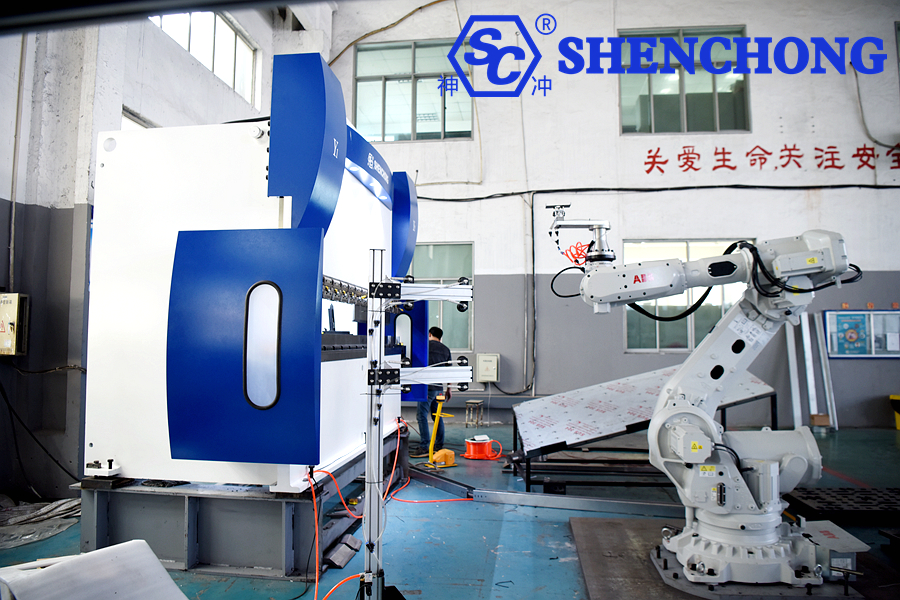
In the metal processing industry, robotic loading and unloading is typically applied in the following scenarios:
- Automatic loading and unloading of laser cutting machines
- Shearing machine sheet metal conveying and recycling
- Automatic grasping and feeding of bending machines
- Loading and unloading and part removal of stamping machines
- Handling and positioning of welding workpieces
- Loading and unloading and workpiece transfer on machine tools
- Automatic sorting and stacking of sheet metal, pipes, and profiles
Its core value lies not only in replacing manual handling, but more importantly, in standardizing, synchronizing, and systematizing the originally discrete, repetitive, and labor-intensive handling processes, thereby making the entire production line more efficient, stable, and controllable.
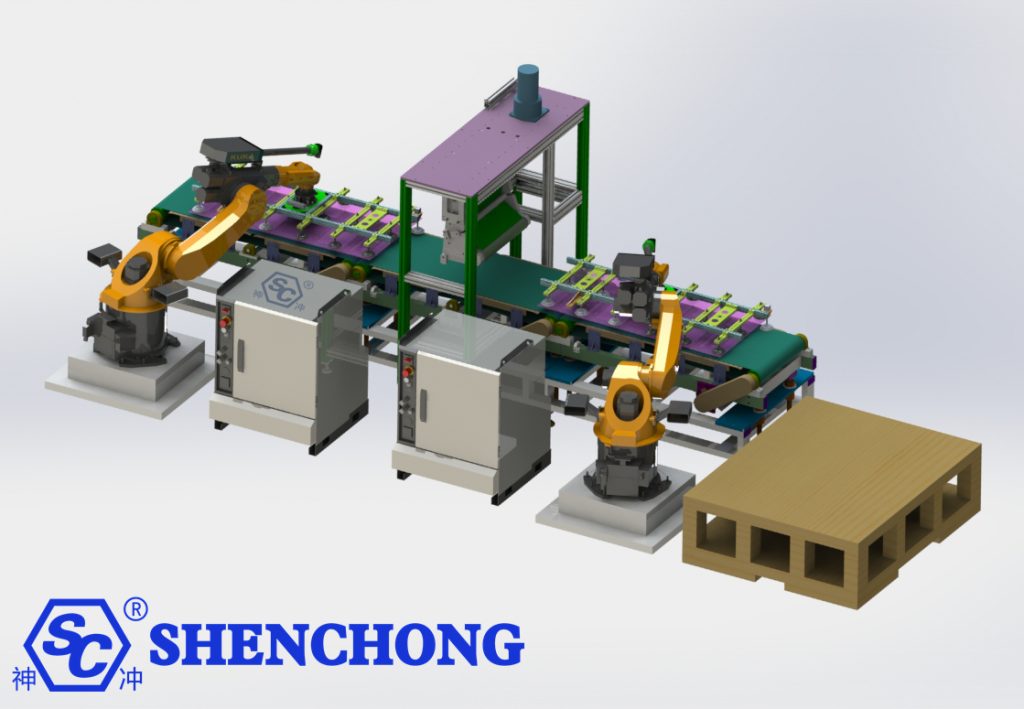
A typical robotic loading & unloading system consists of the following components:
- Industrial robot body (six-axis robot, gantry robot, collaborative robot, etc.)
- Vacuum suction cups or mechanical grippers
- Automatic material storage
- Conveying system
- Positioning platform
- CCD vision positioning system (optional)
- PLC control system
- MES/ERP data interface
- Safety fence and light curtain protection
The entire system can be customized for different equipment, including:
- Laser cutting machine loading and unloading
- CNC bending machine loading and unloading
- Automatic punching machine loading and unloading
- Shearing machine loading and unloading
- Welding station loading and unloading
- Multi-station online production
Truly achieving:
Automatic raw material entry—processing—automatic finished product unloading—automatic palletizing—automatic transfer.
2. Why automatic loading and unloading necessary in the metal processing industry?
The metal processing industry faces several typical pain points in loading and unloading operations:
1) Heavy workpieces and high labor intensity
Sheet metal, profiles, parts, and semi-finished products are often heavy, especially thick plates, long materials, and large-sized workpieces. Manual handling places a significant physical burden on the worker, resulting in low efficiency and easy fatigue.
2) Fast production cycle, making it difficult for workers to keep up
With the continuous improvement in the efficiency of equipment such as laser cutting, CNC punching machines, and CNC press brake bending machines, manual loading and unloading often becomes a bottleneck in the entire production line. Machines operate very quickly, but manual handling speed is limited, easily leading to waiting, material accumulation, and a mismatch between the production cycle and the actual speed.
3) Complex working environment and safety risks
Metal processing sites often involve sharp edges, high-temperature workpieces, oil stains, dust, noise, and the risk of pinching. Frequent entry and exit of workers into the equipment’s working area poses a high safety hazard.
4) High requirements for workpiece consistency
In automated production, the placement, angle, spacing, and posture of workpieces directly affect the quality of subsequent cutting, bending, welding, or assembly. Human operation struggles to maintain consistent precision over the long term, while robots can maintain stable accuracy.
5) Labor shortages and rising labor costs
Metal processing companies, especially medium and large-sized manufacturers, generally face a shortage of skilled handling, assembling, and material handling workers. Once deployed, robotic systems can alleviate reliance on repetitive tasks.
Robot material handling is not only an automated replacement for manual handling but also a crucial foundation for metal processing companies moving towards intelligent manufacturing. Through high efficiency, high precision, high stability, and high safety, it helps companies improve equipment utilization, reduce overall manufacturing costs, enhance product consistency, and meet market demands for diverse, small-batch, and rapid delivery.
For metal processing companies engaged in laser cutting, CNC bending, stamping, and welding, combining robotic material handling systems with automated material handling systems, intelligent warehousing, MES systems, and automated production lines can build an integrated intelligent manufacturing system covering “raw materials—processing—logistics—finished products,” providing strong support for enhancing market competitiveness and achieving digital transformation.
3. Key Features of Robotic Loading and Unloading
In the metal processing industry, robotic loading and unloading systems have evolved from “automation auxiliary equipment” to a core unit of the production line. Whether it’s laser cutting, stamping, bending, welding, or machine tool loading and unloading, material handling and sorting, palletizing and transferring, robot loading and unloading continuously improves production efficiency, stabilizes product quality, reduces labor costs, and drives factories towards intelligent, flexible, and unmanned operation.
1) Achieving Continuous 24/7 Production
The biggest feature of robots is their ability to: Operate continuously 24/7.
Compared to manual labor:
- No need for rest
- Unaffected by fatigue
- Not limited by shifts
- Can still produce on holidays
Especially suitable for:
- Large-volume orders
- Long-term processing
- Unmanned night shift production
For industries such as laser cutting and bending, it can truly realize a “lights-out factory” production mode.
2) High Loading and Unloading Speed
The robot’s movement trajectory is controlled by a program.
Features:
High speed, high acceleration, rapid gripping, rapid unloading.
The entire process is completed continuously:
Material handling → Positioning → Unloading → Machine processing → Part removal → Palletizing.
Compared to manual labor:
Loading and unloading cycle time can typically be increased by: 30%–200%.
Especially in:
CNC bending, CNC shearing, and laser cutting, where the advantages are even more pronounced.
3) High repeatability
Industrial robots typically achieve a repeatability of: ±0.02mm to ±0.08mm.
Compared to manual labor:
No issues arise: Misalignment, tilting, positioning errors, or product collisions, ensuring the equipment always maintains optimal processing conditions.
The advantages are particularly evident for:
Precision sheet metal, stainless steel, aluminum plates, and copper plates.
4) Adaptable to Multiple Product Specifications
Robot Supports:
- Quick Program Change
- Automatic Gripper Switching
- Multiple Workpiece Recognition
- Automatic Coordinate Adjustment
Applicable to:
- Large Boards
- Small Boards
- Long Boards
- Irregularly Shaped Parts
- Pipes
- Profiles
Truly Achieving Flexible Manufacturing.
5) Strong Intelligent Recognition Capabilities
Integrates with:
- CCD Vision
- 3D Vision
- AI Recognition
The robot can automatically recognize:
- Workpiece Position
- Workpiece Orientation
- Workpiece Dimensions
- Stacking Height
- Offset
No manual adjustment required.
Even with slight offsets in the material, the gripping position can be automatically corrected.
4. Core Advantages Of Robot Loading and Unloading
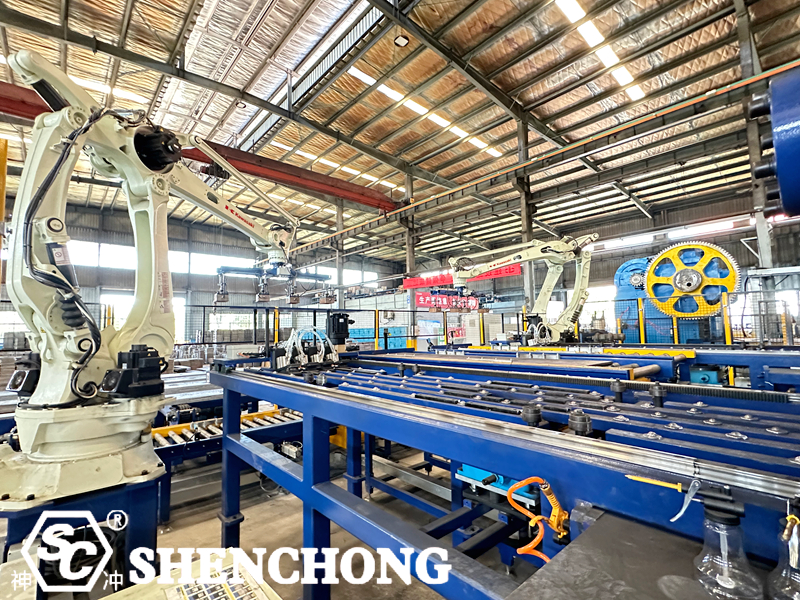
The metal processing industry is characterized by a wide variety of materials, complex sheet metal specifications, high process cycle requirements, and a relatively harsh working environment. While traditional manual loading and unloading methods are flexible, they are increasingly unable to meet the demands of modern manufacturing in terms of efficiency, stability, safety, and long-term costs. In contrast, robotic loading and unloading systems, with their advantages of high repeatability, continuous operation, and adaptability to multi-station collaboration, are becoming an important means for metal processing companies to enhance their competitiveness.
1) Significantly Improved Production Efficiency
The greatest value of robots is: Keeping equipment constantly operational.
Traditional Manual Processing:
After processing is complete:
Manual staff walks over
↓
Picks up material
↓
Places material
↓
Repositions
↓
Starts equipment
The entire process may take: 20–60 seconds.
Robots, on the other hand:
Immediately pick up parts after processing.
Immediately place materials at the start of processing.
Waiting time is almost zero.
Equipment utilization can be increased by: 20%–50%.
2) Reduce Labor Costs
As labor costs in manufacturing continue to rise, robots replacing repetitive tasks such as handling and loading/unloading can effectively reduce long-term labor pressure.
Typically, one robotic loading/unloading system can replace multiple operators (the exact number depends on the process, cycle time, and shift schedule). Companies can also reduce management costs associated with recruitment, training, and employee turnover.
Especially suitable for:
- Three-shift production
- Labor-intensive regions
- Large-volume continuous production enterprises
Long-term operation offers significant overall cost advantages.
3) Improve Product Consistency
Human error presents:
- Fatigue
- Emotional state
- Inconsistent skill levels
Easily causes:
- Positioning deviation
- Workpiece scratches
- Secondary collisions
Robots: All movements are consistent.
Each time:
Grab position
↓
Placement position
↓
Speed
↓
Force
All remain consistent.
Product consistency is significantly improved.
4) Reduced Scrap Rate
Robots feature:
- Precise positioning
- Stable gripping
- Automatic correction
- Automatic detection
Reduces:
- Material deviation
- Workpiece falling
- Workpiece deformation
- Secondary collisions
Therefore: Scrap rate can be significantly reduced.
Especially suitable for high-value materials:
- Stainless steel
- Aluminum alloy
- Copper plate
- Mirror panel
Saving material costs.
5) Enhanced Personnel Safety
Metal processing involves:
- Laser radiation
- High-temperature workpieces
- Sharp plates
- Heavy workpieces
- Crushing hazards
After robots replace manual labor:
Personnel do not need to enter hazardous areas.
Effectively avoids:
- Scratches
- Injuries
- Crushing accidents
- Scalds
Significantly improved safety level.
6) Reduced Labor Intensity
Sheet metal weight: Tens of kilograms
Even: Hundreds of kilograms.
Long-term handling can easily cause:
- Lumbar spine injury
- Shoulder strain
- Occupational diseases
Robots: Completely automated.
Employees are primarily responsible for:
- Monitoring equipment
- Changing programs
- Quality inspection
The working environment is greatly improved.
7) Supporting Flexible Production
Modern manufacturing: Increasingly diverse product specifications.
Orders:
- Small batches
- Multiple varieties
- Short lead times.
Robots only need to switch programs to automatically change products.
No need to retrain employees.
Meets: Flexible manufacturing needs.
8) Improving Overall Equipment Utilization
Robots can form complete production lines with:
- Laser cutting machines
- Bending machines
- Intelligent warehousing systems
- Conveyor lines
- AGVs
Truly achieving: Unmanned processing.
Equipment utilization is further improved.
9) Achieving Digital Management
The robot control system can achieve data interconnection with:
- MES systems
- ERP systems
- WMS warehousing systems
- SCADA systems
Enterprises can monitor in real time:
- Production quantity
- Equipment status
- Workpiece flow
- Cycle time analysis
- Fault alarms
- OEE (Overall Equipment Effectiveness)
Providing data support for lean production and management decisions.
10) Relatively short return on investment cycle
For enterprises with stable orders and high equipment utilization, robotic loading and unloading systems can gradually recover investment by increasing capacity, reducing labor, and decreasing waste. The actual return on investment cycle is affected by factors such as equipment configuration, production cycle time, shifts, labor costs, and product value. Many projects can achieve investment recovery in about 1 to 3 years. Specific assessments should be made based on the actual situation of the enterprise.
5. Typical Application Scenarios
1) Laser Cutting Loading and Unloading
In the laser cutting industry, robotic loading and unloading can achieve functions such as automatic loading of raw materials, automatic unloading after cutting, finished product sorting, and waste recycling.
Its advantages include:
- Reducing the risk of manual handling of large plates
- Improving the continuous operation capability of cutting equipment
- Reducing scratches and positioning deviations on the sheet metal
- Facilitating integration with material storage and pallet systems
For medium and heavy plates, large-volume parts, and high-cycle production, robotic loading and unloading can significantly improve the overall efficiency of laser cutting lines.
2) Bending Machine Loading and Unloading
The bending process requires high positioning accuracy and motion coordination. Robots can assist in completing actions such as sheet metal gripping, flipping, positioning, feeding into the mold, and finished product removal, suitable for standard parts and batch processing.
Its advantages include:
- Reducing the labor intensity of operators
- Improving the accuracy of workpiece entry into the mold
- Reducing human error during the bending process
- Facilitating the automation of bending units
3) Punching Machine Loading and Unloading
Punching production has a fast cycle time and high risk, making robotic loading and unloading particularly valuable. Robots can quickly pick up and place workpieces, synchronizing with the stamping cycle and reducing the need for personnel to enter hazardous areas.
Their advantages include:
- High-speed, high-frequency operation
- High safety
- Suitable for continuous batch production
- Can be integrated with conveyor lines and mold systems
4) Welding and Assembly Handling
Before and after welding, robots can perform workpiece transfer, positioning, flipping, and delivery to the welding station. For complex welding products, robot loading and unloading helps achieve more stable station connections.
5) Warehousing and Logistics Transfer
Between intelligent material warehouses, automated storage, and production line buffer areas, robots can handle handling, sorting, and palletizing tasks, making logistics smoother throughout the workshop and reducing backlog and chaos.
Typical advantages of robot loading and unloading in metal processing:
Application Equipment | Robot Functions | Value Brought |
Fiber Laser Cutting Machine | Automatic feeding, automatic unloading, automatic sorting | Improved cutting efficiency and reduced downtime |
CNC Press Brake | Automatic material picking, positioning, flipping, and finished product unloading | Enhanced bending consistency and enabled continuous processing |
CNC Punching Machine | Automatic feeding, picking up, and stacking | Shorter cycle time and increased capacity |
CNC Machining Center | Automatic part changing, loading and unloading | Enabled multi-machine monitoring and unmanned operation at night |
Shearing Machine | Automatic feeding and receiving | Improved shearing efficiency and ensured operational safety |
Welding Robot Workstation | Automatic workpiece clamping and unloading | Ensured stable welding cycle time and improved weld consistency |
Automated Production Line | Multi-device collaborative loading and unloading | Constructed flexible manufacturing units and improved overall logistics efficiency |
6. Challenges and Solutions for Robotic Loading and Unloading
While robotic loading and unloading offers significant advantages, practical applications require careful planning tailored to the workpiece, process, and site conditions.
1) Significant Workpiece Variation
Metal processing products are diverse, with significant dimensional variations. Appropriate fixtures, program switching, and visual recognition are essential to enhance adaptability.
2) Limited Site Space
Robot systems require consideration of equipment layout, movement radius, safety barriers, and loading/unloading channels. Thorough planning is crucial.
3) Investment Recovery Period Requires Assessment
Different companies have different order structures. Automation upgrades must be evaluated in conjunction with production volume, labor costs, and equipment utilization to assess return on investment.
4) High Maintenance and Debugging Requirements
While robot systems operate stably, they require professional debugging, maintenance, and program management. Companies should establish corresponding technical support systems.
With proper planning, appropriate selection, and complete system integration, robotic loading and unloading can typically achieve highly satisfactory application results.
7. Future Development Trends
In the future, robotic material handling will evolve towards greater intelligence, flexibility, and digitalization, primarily reflected in:
- AI Visual Recognition: Achieving intelligent recognition and grasping of complex workpieces, mixed materials, and randomly placed workpieces.
- Multi-Robot Collaboration: Multiple robots will collaborate to complete material handling, flipping, transfer, and palletizing, further improving cycle time.
- Digital Twins and Offline Programming: Completing process simulation, path optimization, and cycle time verification in a virtual environment, shortening on-site debugging time.
- Expanded Application of Collaborative Robots: Playing a greater role in scenarios such as human-machine collaboration and small-batch flexible manufacturing.
- Intelligent Logistics Integration: Deep integration with AGV/AMR, automated warehousing, and conveying systems to achieve full-process automation from raw material warehousing to finished product outbound.
- Cloud Platforms and Remote Operation and Maintenance: Enabling equipment status monitoring, predictive maintenance, and remote diagnostics, improving system reliability and operational efficiency.
8. Summary
Overall, the core value of robotic loading and unloading in the metal processing industry can be summarized as “improving efficiency, reducing costs, enhancing stability, increasing safety, and promoting intelligence.”
Its characteristics lie in its high degree of automation, stable operation, high repeatability, strong adaptability, and ease of linkage. Its advantages include improved efficiency, reduced costs, ensured safety, improved quality, and promotion of intelligent manufacturing upgrades.
For metal processing enterprises pursuing high efficiency, high consistency, high safety, and high competitiveness, robotic loading and unloading is no longer just an optional solution, but an important path towards modern manufacturing.
As the metal processing industry accelerates its development towards intelligence, digitalization, and flexibility, robotic loading and unloading will continue to play an increasingly important role, becoming a crucial engine for factory quality improvement, efficiency enhancement, and transformation.
Robotic loading and unloading in the metal processing industry is evolving in the following directions:
- Greater flexibility: adapting to more specifications and more complex workpieces
- Strengthened intelligence: combining vision, AI recognition, and automatic deviation correction
- Deeper integration: deep integration with material storage, MES, AGVs, and equipment control systems
- Greater automation: achieving long-term continuous automatic operation
- More modular: facilitating rapid deployment, expansion, and upgrades
In the future, robotic loading and unloading will no longer be just standalone automated components, but will become a standard feature of smart metal processing factories.
 English
  Spanish
  Portuguese
  Russian
  Arabic
  French
  Italian
  German
  Polish
  Thai
Thai  Vietnamese
  Lithuanian
  Czech
Czech  Korean
  Japanese
  Chinese