
Table of Contents
Sheet metal shearing is one of the most fundamental and crucial processes in industries such as sheet metal processing, steel structure manufacturing, machinery manufacturing, electrical cabinets, construction machinery, automotive parts, and shipbuilding. The metal sheet shearing quality directly impacts subsequent bending, welding, stamping, assembly, and the quality of the finished product.
In actual production, many companies encounter the following problems:
- Excessive shearing burrs
- Uneven sheared surfaces
- Large workpiece dimensional errors
- Sheet metal deformation and warping
- Shearing edge cracking
- Sheet surface scratches
- Poor batch consistency
- Reduced bending accuracy in subsequent processes
Therefore, improving the quality of metal sheet shearing not only enhances product quality but also reduces rework rates, increases production efficiency, and lowers production costs.
This article will provide a comprehensive analysis from multiple perspectives, including equipment, cutting tools, process parameters, material management, operating techniques, automation systems, and maintenance.
1. What is Metal Sheet Shearing Quality?
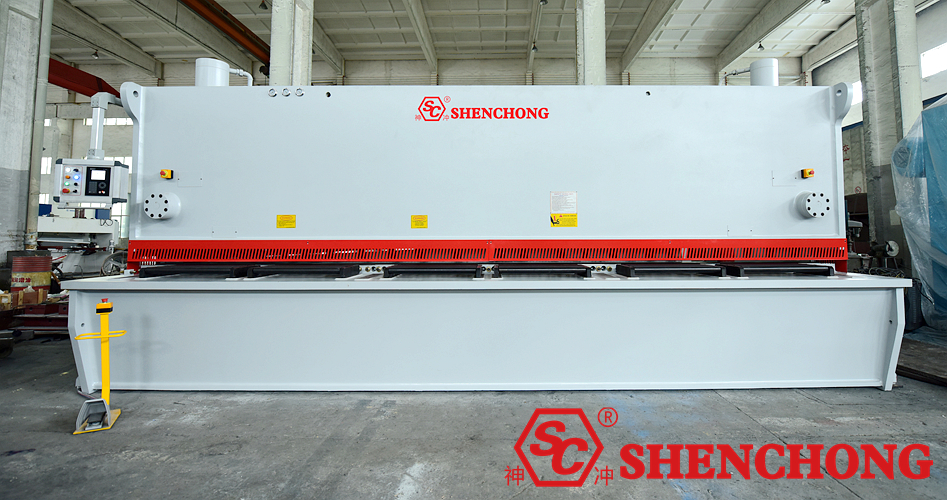
A high-quality sheared section typically includes the following characteristics:
1) High Dimensional Accuracy
Manifested as:
- Accurate length
- Accurate width
- Small diagonal error
- High repeatability
For example:
- ±1mm
- ±2mm
- ±5mm (Varies depending on industry requirements)
2) Smooth Section
A high-quality sheared section should include:
- Uniform bright band
- Straight shear band
- Regular fracture band
Typical section structure:
Upper rounded corner area
↓
Bright band
↓
Fracture band
↓
Burr area
A higher proportion of bright band:
- Better section
- Easier subsequent processing
3) Small Burrs
Ideal state:
- No burrs
- Micro-burrs
General requirements:
Plate thickness | Burnt tolerance |
Less than 1mm | ≤0.03mm |
1~3mm | ≤0.05mm |
3~6mm | ≤0.1mm |
More than 6mm | ≤0.2mm |
4) No Deformation
Indicated by:
- No Wavy Texture
- No Bending
- No Twisting
- No Warping
5) No Surface Damage
Including:
- No Scratches
- No Indentations
- No Bumps
2. What constitutes good shearing quality?
The metal sheet shearing quality directly affects the efficiency of subsequent bending, welding, assembly, painting, and the entire production line, as well as the appearance of the finished product.
“Shearing quality” is not simply about “cutting cleanly,” but must simultaneously meet requirements such as accurate dimensions, flat end faces, minimal burrs, small corner collapses, good straightness, minimal surface damage, minimal heat-affected zones or deformation, and high batch consistency.
Especially in industries such as sheet metal processing, steel structures, machinery manufacturing, appliance casings, and engineering equipment, the shearing process is often the first critical step. If the quality here is unstable, subsequent corrections will increase costs.
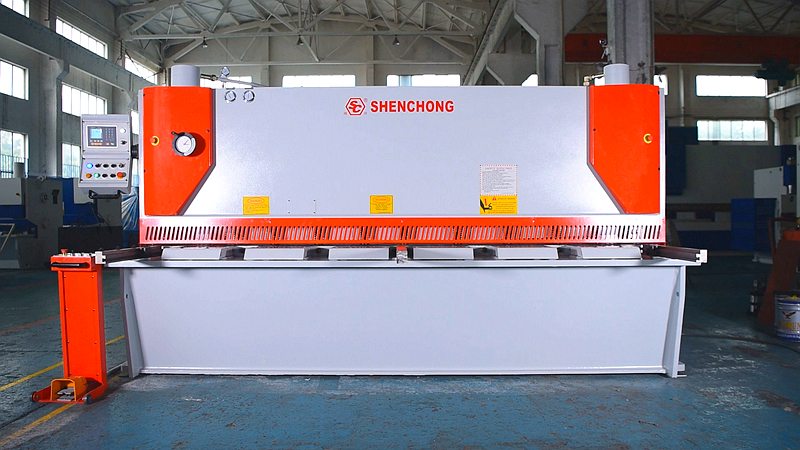
These are the core indicators typically used to judge shearing quality.
1) High Dimensional Accuracy
The cut length, width, diagonals, and parallelism should conform to the drawing requirements as closely as possible, with stable and controllable errors. For batch parts, consistency is more important than individual pieces being “just right.”
2) Smooth Cut Edges and Good Perpendicularity
Ideally, the edges of the sheet should be as straight and flat as possible, with no significant tilting on the sides. Excessive slant in the cut surface indicates problems with tool clearance, blade condition, or machine tool accuracy.
3) Minimal Burrs
Excessive burrs not only affect appearance but can also scratch the workpiece, affect assembly, increase grinding processes, and even create safety hazards.
4) Minimal Corner Collapse and Extrusion Deformation
Significant corner collapse or material tearing at the inlet and outlet of the sheet indicates unsuitable cutting parameters or dull blades.
5) No Obvious Indentations, Scratches, or Grafts on the Sheet Surface
Especially for materials with high surface finish requirements, such as stainless steel, aluminum, galvanized steel, and coated steel, careful control of material clamping, guiding, handling, and blade surface condition is crucial.
6) Good batch stability
Truly excellent cutting quality is not about cutting one good sheet, but about maintaining stability when cutting many sheets consecutively. Stability is more important than a single, accidental success.
3. Main Factors Affecting Metal Shearing Quality
The main factors affecting metal sheet shearing quality include:
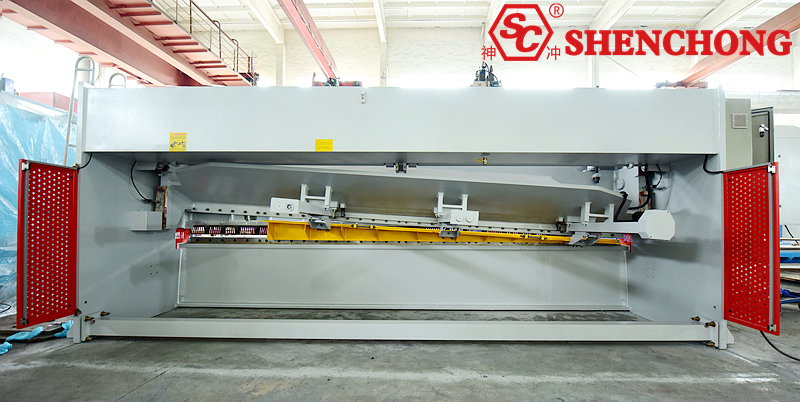
Equipment Factors (approx. 35%~40%)
- Frame Rigidity
- Hydraulic System
- Guide Rail Accuracy
- Backgauge Accuracy
Blade Factors (approx. 20%)
- Blade Material
- Sharpness
- Gap Adjustment
Process Parameters (approx. 20%)
- Shearing Angle
- Pressure Force
- Stroke
Material Factors (approx. 10%)
- Material
- Thickness
- Smoothness
Personnel Operation (approx. 10%)
- Machine Adjustment Ability
- Process Experience
4. Properly Adjusting the Blade Gap
This is the most crucial method for improving metal sheet shearing quality.
Why is blade clearance important?
Small blade clearance:
Results:
- Rapid blade wear
- Increased shearing force
- Blade chipping
Large blade clearance:
Results:
- Increased burrs
- Rougher cut surface
- Increased dimensional errors
Common clearance selection
Empirical formula:
Clearance = Plate thickness × 5%~10%
Example:
Plate thickness | Recommended gap |
1mm | 0.05~0.08mm |
2mm | 0.1~0.16mm |
4mm | 0.2~0.32mm |
8mm | 0.4~0.64mm |
12mm | 0.6~0.96mm |
Gap between different materials:
- Stainless steel (high hardness): Recommended: 6%~8%
- Carbon steel: Recommended: 8%~10%
- Aluminum plate: Recommended: 4%~6%
- Copper plate: Recommended: 5%~7%
5. Choosing High-Quality Blades
Blades determine the upper limit of shearing quality.
Common Blade Materials
1) 9CrSi
Advantages:
- Low cost
- Good toughness
Disadvantages:
- Moderate lifespan
2) 6CrW2Si
Advantages:
- Good wear resistance
- Impact resistance
3) Cr12MoV
Most common
Characteristics:
- High hardness
- High wear resistance
4) H13
Suitable for heavy-duty production
Long lifespan
5) SKD11
High-end blades
Characteristics:
- Ultra-high wear resistance
- Stable precision
Blade Wear Control
Regular Inspection:
Observation:
- Notches
- Chipping
- Rounding
Resharpen immediately if any of the following occur:
- Burrs increase by more than 30%
- Shearing force increases significantly
- Cutting surface deterioration
6. Improving Equipment Rigidity
Equipment rigidity determines precision and stability.
Insufficient Rigidity Manifestations
Common Phenomena:
- Longer shearing length results in greater error
- Middle concavity
- Different dimensions at both ends
Improvement Methods
Thicken the frame
- Integral welded structure
- Stress relief treatment
Add reinforcing ribs
- Reduce deformation
Integral tempering
- Improve stability
Finite element optimization design
- Commonly used in modern high-end shearing machines.
7. Properly Setting the Pressing System
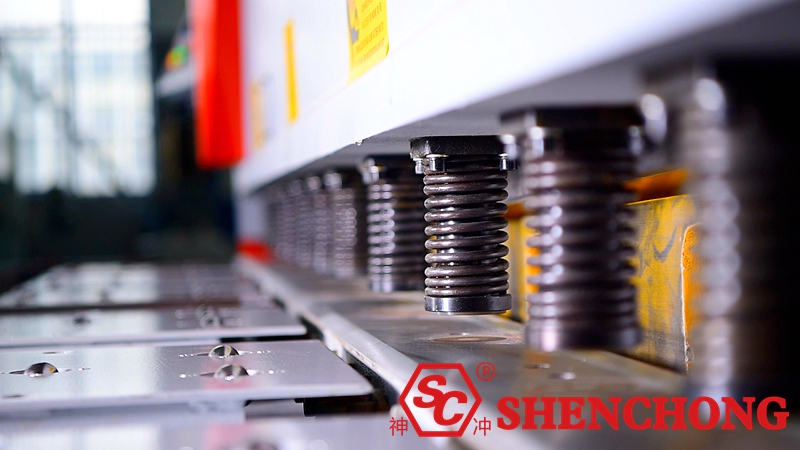
Insufficient pressing force is a major cause of sheet metal deformation.
1) Low pressing force
Sheet metal is prone to:
- Slipping
- Lifting
- Warping
2) High pressing force
Easily:
- Damaging the sheet metal
- Surface indentation
3) Correct Methods
Based on:
- Sheet thickness
- Material strength
Automatically adjust the pressing force.
High-end hydraulic shearing machines commonly use:
Independent hydraulic pressing system.
8. Controlling the Shear Angle
The shear angle determines:
- Shear force
- Cross-sectional quality
Excessively large shear angle
Advantages:
- Power saving
Disadvantages:
- Sheet material is prone to twisting
Excessively small shear angle
Advantages:
Good quality
Disadvantages:
Increased equipment load
Recommendation:
Plate thickness | Shear angle |
1-4mm | 0.5°- 1° |
4-10mm | 1°- 1.5° |
10mm or more | 1.5°- 2° |
9. Improving Backgauge Accuracy
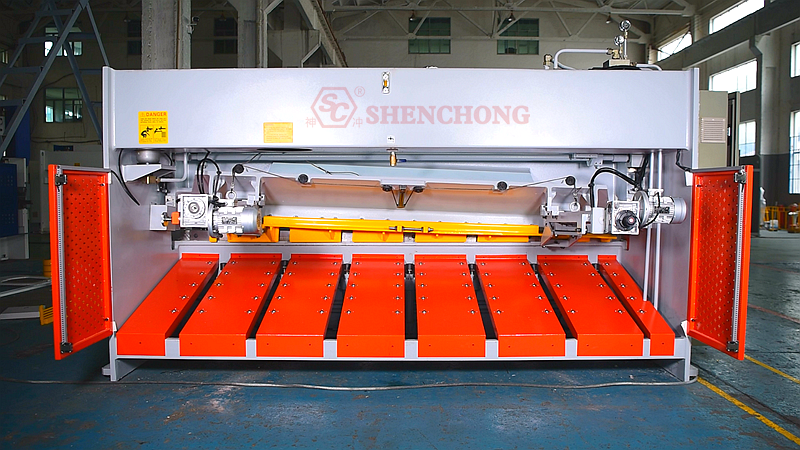
Backgauge error directly affects dimensions.
Common Problems
- Inaccurate repeatability
- Large lead screw backlash
- Guide rail wear
Solutions
Ball screw
- Replace ordinary lead screw
Linear guide
- Improve accuracy
Servo drive
- More accurate positioning
CNC system compensation
- Automatic error correction
High-end equipment:
Repeatability can reach±0.02mm
10. Reducing Sheet Deformation
Causes of deformation
Including:
- Internal stress
- Insufficient pressure
- Unreasonable gap
Control Methods
- Segmented shearing
- Large sheets are sheared in segments.
Pre-leveling
- Leveling before shearing.
Adjusting pressure points
- Improving stability.
Using a guillotine shearing machine
Compared to a swing beam shearing machine:
- Higher rigidity
- Less deformation
11. Improving Raw Material Quality
Even the best equipment cannot compensate for inferior materials.
Inspection Items
- Thickness consistency
- Excessive thickness fluctuation will affect gap.
Flatness
- Wavy sheets will affect positioning.
Surface Condition
- Rust accelerates blade wear.
Material Hardness
- Uneven hardness leads to dimensional fluctuations.
12. Automated Loading and Unloading Improves Quality
Traditional Manual Methods:
Prone to:
- Bumps
- Scratches
- Positioning Errors
Automation Advantages
Vacuum suction cup positioning
- Stable positioning
Mechanical gripper positioning
- High repeatability
Automatic palletizing
- Reduces bumps and knocks
Automatic sorting
- Improves efficiency
For mass production
Automation can:
- Increase yield by over 10%
- Reduce human error by over 80%
13. Establishing a Standardized Process Database
Excellent companies establish: Process database
Records:
- Material
- Thickness
- Gap
- Shearing angle
- Clamping pressure
For example:
Material | Thickness | Gap |
Q235 | 2mm | 0.15mm |
Q235 | 4mm | 0.3mm |
304 | 2mm | 0.12mm |
Setup time can be reduced by more than 50%.
14. The Impact of Equipment Maintenance on Quality
Many companies neglect maintenance.
In reality: The condition of the equipment determines the condition of the product.
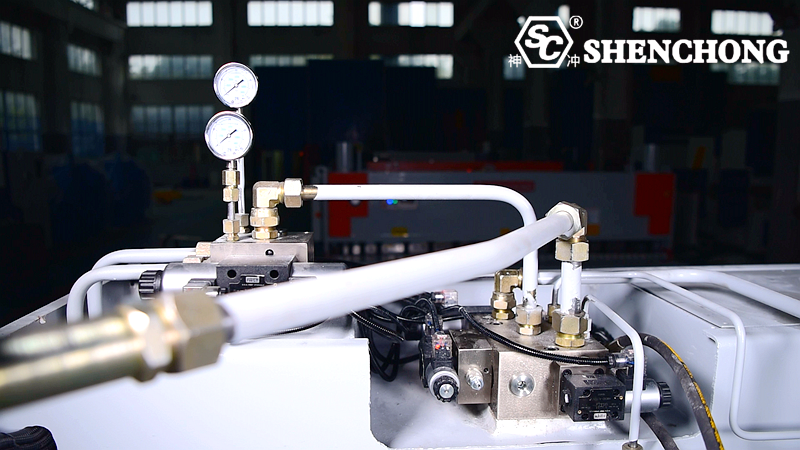
Routine Maintenance
Daily:
Inspect:
- Hydraulic oil
- Guide rails
- Blades
Weekly Maintenance
Inspect:
- Bolts
- Pressure cylinder
- Back gauge
Monthly Maintenance
Inspect:
- Hydraulic system
- Electrical system
- Precision calibration
Annual Maintenance
Includes:
- Hydraulic oil replacement
- Full machine calibration
- Precision testing
15. Optimal Shearing Strategies for Different Materials
Carbon Steel
Features:
- Most widely used
Recommendation:
- Standard clearance
- Medium pressure
Stainless Steel
Features:
- High springback
- High strength
Recommendation:
- Reduce clearance
- Use SKD11 blades
Aluminum Plate
Features:
- Easily scratched
Recommendation:
- Protective film
- Dedicated soft pressure
Copper Plate
Features:
- Sticks to blade
Recommendation:
- Clean blade edge frequently
Nickel Plate
Features:
- High strength
- High value
Recommendation:
- Precision shearing
- Automatic loading and unloading
- Scratch-resistant design
16. Digitalization and Intelligentization Improve Shearing Quality
Modern intelligent shearing machines have entered the Industry 4.0 era.
Main Functions:
- Automatic gap adjustment
Automatic plate thickness matching
- Automatic shearing angle adjustment
Optimized cross-sectional quality
- Automatic pressure compensation
Maintaining consistency
- Real-time monitoring system
Monitoring:
- Pressure
- Temperature
- Vibration
MES Networking
Achieving:
- Data traceability
- Quality management
- Process optimization
17. Comprehensive Implementation Plan for Improving Shearing Quality
For a metal processing enterprise, it is recommended to optimize in the following order:
Phase 1 (Basic Improvement)
- Calibrate equipment accuracy
- Adjust blade gap
- Replace worn blades
- Establish maintenance system
Quality improvement approximately 15%–25%.
Phase 2 (Process Optimization)
- Establish process database
- Optimize shearing angle
- Optimize material clamping system
- Standardize operating procedures
Quality improvement approximately 20%–30%.
Phase 3 (Equipment Upgrade)
- CNC Backgauge
- Servo System
- Automatic Gap Adjustment
- High-Precision Gustle Structure
Quality improvement of approximately 20% or more.
Phase 4 (Intelligent Manufacturing)
- Automated Loading and Unloading System
- Intelligent Warehousing System
- MES System
- Online Inspection System
Yield rate can reach: Over 99%.
18. Summary
Improving the metal sheet shearing quality is a systematic project that cannot rely on just one aspect. It requires coordinated optimization from multiple aspects, including equipment, blades, process parameters, material management, operating procedures, maintenance, and automation technology.
To truly achieve stable shearing quality, the core idea can be summarized in four sentences: Sharp blade, precise gap, stable clamping, and accurate positioning.
Six key factors:
- Properly adjust blade clearance
- Use high-quality wear-resistant blades
- Improve overall equipment rigidity
- Precisely control clamping force and shearing angle
- Improve back gauge positioning accuracy
- Establish a standardized process database and preventative maintenance system
Based on these factors, further optimizing process parameters based on material characteristics, improving feeding support methods, and ensuring proper equipment maintenance and first-piece inspection are crucial for achieving consistently high-quality shearing results.
From a practical perspective, the most common and effective improvement methods are:
First, repair the blades, then adjust the clearance; first, stabilize the clamping force, then calibrate the back gauge; first, ensure equipment precision, then consider batch quality.
By doing these fundamental tasks well, the shearing quality of sheet metal can usually be significantly improved, and the greater the batch and standardization of production, the greater the benefits.
For modern sheet metal factories, adopting high-precision CNC hydraulic guillotine shearing machines, servo back gauge systems, automatic loading and unloading devices, and intelligent process management platforms has become an important development direction for achieving high-quality, high-efficiency, and low-cost shearing production.
Through system optimization, enterprises can not only significantly improve the quality and dimensional accuracy of sheared sections, but also reduce blade consumption, decrease scrap rates, and provide a more stable and reliable processing foundation for subsequent bending, welding, and assembly processes.

 English
  Spanish
  Portuguese
  Russian
  Arabic
  French
  Italian
  German
  Polish
  Thai
Thai  Vietnamese
  Lithuanian
  Czech
Czech  Korean
  Japanese
  Chinese