
Table of Contents
3-roll bending process (also known as a three-roller plate rolling) is one of the most classic and widely used circular forming in the field of metal sheet forming. It is widely used in pressure vessels, air ducts, storage tanks, steel structures, shipbuilding, bridges, and machinery manufacturing industries.
Below is a systematic and in-depth analysis of its working principle, structural composition, forming mechanism, technical characteristics, advantages, comparison of different structural forms, and application scenarios.
1. Basic Working Principle of 3-Roll Bending Process
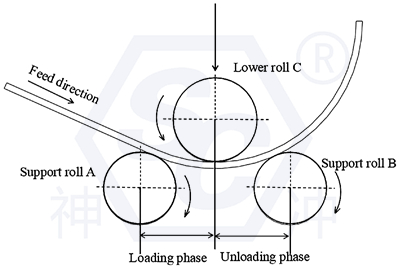
The core principle of three-roll plate rolling is: By changing the relative positions of the three rollers, the sheet metal undergoes continuous plastic bending deformation under stress, ultimately forming the desired arc or cylindrical shape.
1) Basic Structural Components
A standard three-roll plate rolling machine typically consists of:
- Upper roller (main roller)
- Lower roller (support roller)
- Side rollers (adjusting rollers)
- Main drive system
- Hydraulic system
- Electrical control system
- Tilting mechanism (for unloading)
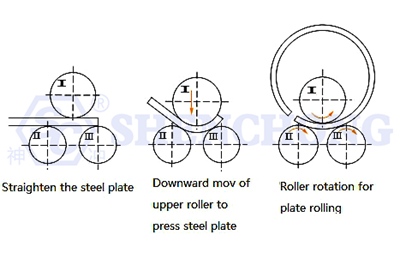
2) 3-Roll Bending Forming Process
Step 1: Plate Feeding and Positioning
The sheet metal is inserted between the upper and lower rollers.
Step 2: Side Roller Lifting and Lowering
The side rollers rise or fall, changing the three-point support position.
Step 3: Generating Bending Moment
As the sheet metal passes through the three rollers:
- The upper roller applies pressure.
- The lower roller provides support.
- The side rollers control the bending radius.
- The sheet metal undergoes continuous plastic deformation.
Step 4: Repeated Feeding
Through repeated rolling, the bending gradually reaches the set radius.
Step 5: Complete the forming process
Form a cylindrical or arc-shaped work piece.
2. Mechanical Principles of Three-Roll Plate Rolling
The essence of 3-roll plate bending is: Continuous three-point bending forming
Mechanical characteristics:
The upper roll is the driving roll (in most structures)
The plate is subjected to bending moment
The outer side of the plate is under tension
The inner side is under compression
The neutral layer remains essentially unchanged
When the stress exceeds the material’s yield strength, plastic deformation occurs.
Principle of Bending Radius Control
The bending radius depends on:
- Roller spacing
- Side roll position
- Plate thickness
- Material strength
- Upper roll pressure
The closer the side roll is to the upper roll:
→ Smaller bending radius
→ Greater forming curvature
3. Structural Types of Three-Roll Plate Rolling Machines
– Symmetrical Three-Roll Plate Rolling Machine
– Asymmetrical Three-Roll Plate Rolling Machine
– Mechanical Level Down Plate Rolling Machine
– Upper Roller Universal Plate Rolling Machine
Custom configurations are available based on plate thickness, processing precision, and automation requirements.
1) Symmetrical 3-Roll Plate Bending Machine
- Features: Two lower rollers are fixed; the upper roller lifts vertically.
- Advantages: Simple structure; low cost; suitable for medium and heavy plates.
- Disadvantages: Requires pre-bending assistance; slightly lower precision.
2) Asymmetrical Three-Roll Plate Rolling Machine
- Features: Lower roller is adjustable; one side roller is movable.
- Advantages: Can be pre-bent directly; easier operation; higher precision.
- Suitable for: Small and medium-sized processing plants.
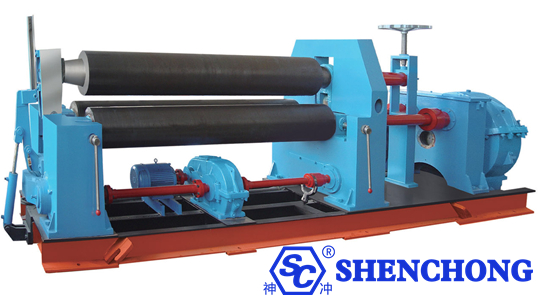
3) Level Down Three-Roll Plate Rolling Machine
Features: Two side rollers move horizontally; the upper roller is fixed.
Advantages: High precision; high degree of automation; suitable for large plates.
4) Upper Roller Universal Three Plate Rolling Machine
- Features: This machine is hydraulic 3-roll bending machine, used to complete the processes of pre-bending, rounding, and straightening at the end of various containers without the need to turn around after one feeding.
- Advantages: With hydraulic system, it is suitable to roll thick metal sheet. Upper roller universal type machine can add the cone rolling device to roll the conical shapes.
- Suitable to produce heavy duty plate rolling machine model and its price is lower than 4 roller rolling machine.
4. Features & Advantages: 3-Roll Bending Equipment
The following is a detailed breakdown of its advantages:
1) Strong Structural Stability
The three rolls form a three-point support structure, resulting in balanced stress, strong load-bearing capacity, and suitability for heavy-duty processing. Especially suitable for: Pressure vessels, storage tank bodies, and large steel structures.
2) Wide Forming Range
Can process: Cylinders, Cones (with conical devices), Curved plates, and multi-segment curves. Material types include: Carbon steel, Stainless steel, Aluminum plates, High-strength plates, and Alloy steel.
3) High-Efficiency Continuous Forming
Compared to bending machines: Bending machines perform multi-segment bending, while three-roll roller forming involves continuous bending.
Therefore: Smoother surface, better roundness, and more precise weld joints.
4) Strong Pre-Bending Capability
Supports partial structural pre-bending: Plate head pre-bending, plate tail pre-bending, reducing straight edge residue.
Improvements:
- Material utilization rate
- Welding quality
- Finished product aesthetics
5) Large potential for automation upgrades
Modern three-roll plate bending machines can be equipped with:
- CNC control system
- Automatic diameter measurement system
- Automatic feeding system
- Angle compensation system
- Automatic centering system
Achievements:
- One-click rolling
- Parameter memory
- Mass production
6) Energy saving and drive advantages
Main drive methods:
- Mechanical transmission
- Hydraulic transmission
- Full servo drive
Among them:
- Hydraulic is suitable for heavy loads
- Servo is suitable for high precision
5. Comparison between three-roll rolling machine and four-roll plate rolling machine
Comparison table of 3-roll bending and 4-roll:
Comparison Items | 3-roll | 4-roll |
Structural Complexity | Simple | Complex |
Cost | Lower | Higher level |
Operational Difficulty | Slightly higher | Simpler level |
Pre-bending Capacity | Partially supported | More powerful |
Automation | Upgradeable | More suitable for automation |
The advantages of three-roller compressors are: economical and practical, structurally stable, and easy to maintain.
Technical Principles and Structural Advantages:
1) Continuous Three-Point Bending Forming
The equipment consists of a three-point support system composed of an upper roller, a lower roller, and side rollers. By adjusting the position of the side rollers, the stress state of the sheet metal is changed, allowing the sheet metal to gradually reach the set bending radius during rolling, achieving uniform and stable plastic deformation.
- Outer layer of the sheet metal is under tension
- Inner layer is under compression
- Neutral layer is stable
- The forming process is continuous and smooth
2) High-Strength Frame Structure
- Integral welded frame
- High-rigidity side plate structure
- Large-diameter alloy steel rollers
- Heavy-duty bearing system
Ensuring stable operation and precise control even when rolling thick plates and large diameters.
3) Pre-bending Function Design
Supports pre-bending at the head and tail of the sheet metal, effectively reducing straight edge residue, improving material utilization and welding quality, especially suitable for manufacturing high-requirement container shells.
6. Key Technical Indicators
Main technical parameters include:
- Maximum coil thickness
- Maximum coil width
- Upper roller diameter
- Lower roller diameter
- Minimum coil diameter
- Main motor power
- Rolling speed
- Pre-bending thickness
Key Technical Parameters (Sample Template)
(The following are template parameters; actual project parameters can be adjusted according to requirements.)
Item | Technical Parameters |
Maximum coil thickness | 2500 mm |
Maximum coil width | ≤ 245 MPa |
Material yield strength | φ320 mm |
Upper roll diameter | φ280 mm |
Lower roll diameter | ≥ φ350 mm |
Minimum coil diameter | 15 kW |
Main motor power | 4–6 m/min |
Rolling speed | ≥ 16 mm |
Pre-bending thickness | 2500 mm |
We can perform verification calculations based on the strength grade of the customer’s board material.
7. Summary of the Core Advantages of 3-Roll Bending Machines
In short:
Three-roll bending machines are classic equipment for “continuous plastic bending forming,” possessing comprehensive advantages such as structural stability, high load-bearing capacity, economical cost, and a wide processing range.
8. Typical Application Industries
- Pressure vessel manufacturing
- Wind turbine towers
- Petrochemical storage tanks
- Shipbuilding
- Pipeline engineering
- Large steel structures
9. Technological Development Trends
Future development directions:
- Full CNC
- Servo electrification
- Automatic compensation system
- Integration with laser cutting
- Smart factory integration
- Data acquisition and remote maintenance
 English
  Spanish
  Portuguese
  Russian
  Arabic
  French
  Italian
  German
  Polish
  Thai
Thai  Vietnamese
  Lithuanian
  Czech
Czech  Korean
  Japanese
  Chinese