
Table of Contents
Heavy-duty profile storage systems are intelligent warehousing equipment specifically designed for long, heavy profiles such as steel structures, aluminum profiles, stainless steel profiles, square tubes, round tubes, I-beams, H-beams, channel steel, angle steel, and rail steel. Through technologies such as automated storage, automated material handling, intelligent management, and information control, it achieves high-density storage, high-efficiency scheduling, and safe handling of long materials. It is an important component of modern intelligent manufacturing, steel structure manufacturing, sheet metal processing, construction machinery, rail transportation, and automobile manufacturing industries.
With the development of Industry 4.0, digital factories, and intelligent manufacturing, traditional manual stacking methods of profiles can no longer meet the requirements of enterprises for efficiency, safety, inventory management, and space utilization. Heavy-duty profile storage systems are gradually becoming an important piece of equipment for modern factory upgrades.
1. What is a heavy-duty profile storage system?
A heavy-duty profile storage system is intelligent warehousing equipment specifically designed for storing, managing, and automatically handling large, heavy metal profiles. The profiles mentioned here typically include I-beams, channel steel, H-beams, square tubes, rectangular tubes, round tubes, angle steel, flat steel, as well as some large aluminum profiles, structural components, and long strip metal materials.
Unlike ordinary light-duty shelving, heavy-duty profile storage systems emphasize the unity of “load-bearing capacity, storage and retrieval efficiency, space utilization, safety and stability, and information management capabilities.” These systems typically serve industries such as steel structure manufacturing, construction machinery, shipbuilding, rail transportation, bridge construction, heavy equipment, and building materials processing.
Due to the characteristics of profiles—”long length, heavy weight, numerous specifications, difficult handling, and irregular stacking”—traditional ground stacking methods not only occupy space but also easily cause material deformation, mixing, corrosion, difficulty in finding materials, and safety hazards.
Therefore, heavy-duty profile storage systems are gradually becoming an important infrastructure in modern metal processing plants, intelligent manufacturing workshops, and large logistics centers.
2. The Core Value of Automated Heavy-Duty Profile Storage Systems
The significance of heavy-duty profile storage systems goes beyond simply “standing materials upright.” It involves restructuring material management processes through mechanization, automation, and digitalization.
First, it significantly improves space utilization. Traditional floor stacking of profiles often requires substantial turnover space and forklift aisles, consuming significant warehouse floor space. Automated, modular, and automated storage systems fully utilize vertical space, multiplying the amount of material that can be stored per unit area.
Second, it improves material retrieval efficiency. Systems typically include pallets, storage compartments, lifting mechanisms, traversing mechanisms, and automatic positioning functions, enabling rapid location of target profiles according to specifications, reducing manual searching and repetitive handling time. This is especially important for factories with a wide variety of specifications and frequent order changes.
Third, it enhances the accuracy of material management. The system can integrate with ERP, MES, WMS, and other management systems to achieve digital management of inbound, outbound, inventory, batch, specification, weight, location, and inventory status, preventing mis-issuance, omissions, material mixing, and discrepancies between records and actual stock.
Finally, it significantly improves safety and material quality. If profiles are stored outdoors or on the ground for extended periods, they are prone to moisture damage, rust, bending, and impacts, and may even lead to safety accidents due to improper manual handling. Heavy-duty profile storage systems allow for more organized material storage, reducing the risk of damage and accidents.
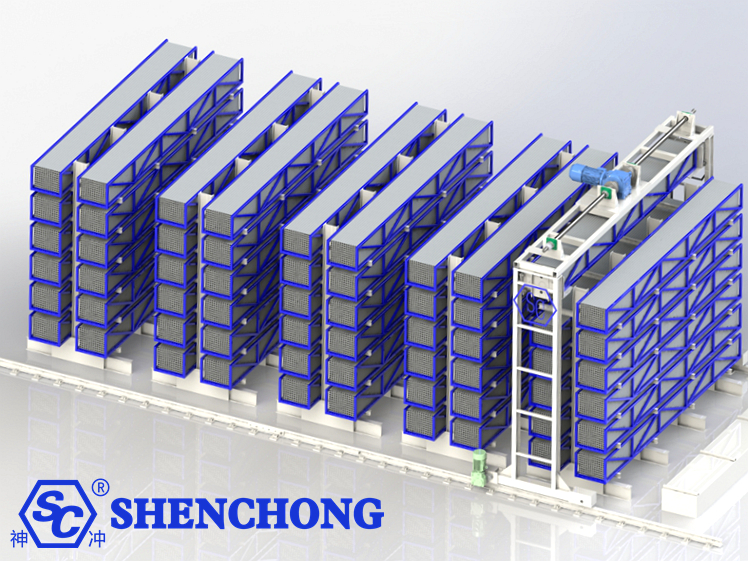
3. Automatic Profile Storage System Composition
A complete heavy-duty profile storage system typically consists of multiple functional modules.
1) Main Steel Structure
The main frame is constructed using heavy-duty welded steel, including:
- Main columns
- Beams
- Guide rails
- Strengthening ribs
- Anchoring system
Features:
- High-strength steel
- Deformation-resistant design
- Good seismic performance
- Capable of supporting tens of tons of weight
Large warehouses typically reach heights of:
- 4m
- 6m
- 8m
- 10m
- 12m
- 15m
Even exceeding 20 meters.
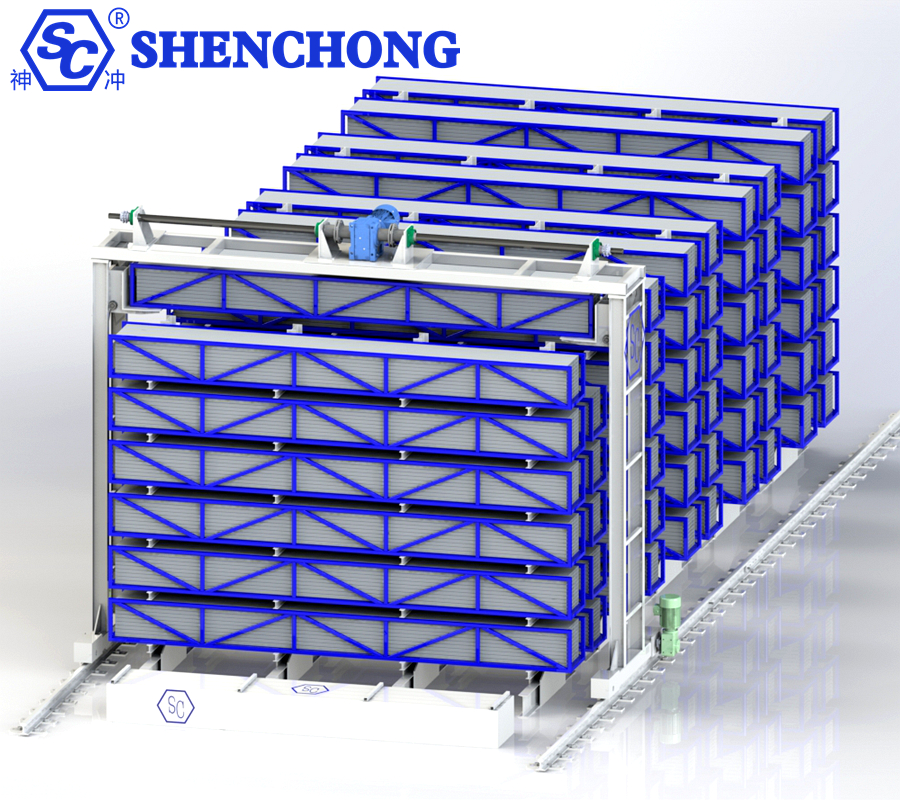
2) Drawer-Type Silos
Profiles typically utilize drawer-type storage locations.
Each layer can be independently pulled out.
Features include:
- Automatic extension
- Automatic locking
- Anti-tipping design
- Anti-derailment design
The load-bearing capacity of each layer typically includes:
- 1000kg
- 2000kg
- 3000kg
- 5000kg
- 8000kg
- 10000kg
Heavy-duty silos can reach over 15 tons.
3) Automated Material Handling Mechanisms
Mainly includes:
Gantry crane handling
- Suitable for: Long profiles, Heavy steel materials
- Advantages: High load capacity, High precision
Gantry robots
- Suitable for: Automated loading and unloading, Automated delivery
- Advantages: High efficiency, Automatic position recognition
- Commonly used in large steel structure factories.
- Features: Can cover the entire warehouse, Multi-station operation
AGV transport vehicles
- Realize: Warehouse- Cutting machine – Machining center – Welding area
- Automated logistics transportation.
4) Lifting Mechanisms
Responsibilities:
Automatic layer picking, Automatic positioning, Automatic lifting
Types include:
Chain lifting, Suitable for:
Medium loads.
Wire rope lifting:
High speed.
Hydraulic lifting:
High stability.
Servo motor synchronous lifting:
Currently the most widely used.
Advantages: High precision, Low noise, Low energy consumption
5) Control System
Generally equipped with a PLC control system.
Includes:
- PLC
- Touchscreen
- Industrial Computer
- Servo Controller
- Encoder
- Laser Positioning
- RFID Identification
Supports:
- MES
- ERP
- WMS
- SCADA
Data Interconnection
4. Main Storage Objects
Heavy-duty profile warehouse can store:
Steel Structures:
H-beams, I-beams, Channel steel, Angle steel, T-beams
Pipes:
Square tubes, Round tubes, Rectangular tubes, Galvanized tubes, Stainless steel tubes
Aluminum Profiles:
Including Industrial aluminum profiles, Door and window profiles, Photovoltaic profiles, Radiator profiles
Special Profiles:
For example: Railway rails, Guide rails, Elevator tracks, Automobile longitudinal beams, Construction formwork
5. Examples of common technical parameter representations
Item | Common range |
Profile Length | 3~15m |
Maximum Length | Customizable 18~24m |
Single Layer Load | 1~10 tons |
Total Warehouse Load Capacity | 100~1000 tons and above |
Number of Layers | 6~30 floors |
Retrieving Speed | 20~90m/min |
Lifting Speed | 10~60m/min |
Positioning Accuracy | ±0.5~2mm |
Control Method | PLC+Servo |
Operating Method | Automatic/Manual/Remote |
6. Intelligent Storage Ssystem Workflow
A typical workflow is as follows:
- The production system issues a material requisition task.
- The WMS automatically calculates the optimal storage location.
- The lifting mechanism moves to the target layer.
- The drawer storage automatically extends.
- The handling device grabs the profile.
- The AGV or conveyor line delivers the material to the processing equipment.
- The system automatically updates inventory information.
- After processing, any remaining materials are automatically returned to the warehouse.
- The entire process requires no manual handling and is fully automated.
7. Key Technical Points in System Design
While a heavy-duty profile storage system may seem like a “storage device,” its design is actually quite complex, focusing on balancing load-bearing capacity, stability, precision, and efficiency.
1) Load-bearing Capacity Design
Profiles are heavy and often subject to eccentric loading and long-span loads, unlike ordinary pallets which are subjected to uniform stress. Therefore, racks and pallets must be designed based on the maximum single-piece weight, layer load, total load, eccentric load, and dynamic impact coefficient. Static load alone is insufficient; impacts and vibrations during handling must also be considered.
2) Anti-deformation design for long profiles
Profiles are typically long, and improper support point arrangement can easily lead to central sagging, edge warping, or permanent deformation. A proper design requires controlling the spacing between support points and developing specialized material support structures for different cross-sections, adding anti-rolling, anti-slip, and anti-deviation devices when necessary.
3) Positioning accuracy design
In automated systems, profile storage requires high positioning accuracy. Especially when the storage location connects with hoisting, shuttle, stacking, and AGV systems, inaccurate positioning can easily lead to jamming, collisions, and alignment failures. Therefore, guiding mechanisms, limit switches, detection sensors, and positioning logic are crucial.
4) Aisle and cycle time design
Heavy-duty profile storage systems must ensure both storage capacity and unobstructed inbound and outbound aisles. Overly dense storage areas will affect material retrieval efficiency. Overly wide aisles will waste space. The design must consider parameters such as average daily inbound/outbound volume, peak order volume, material change frequency, and equipment speed for a comprehensive balance.
8. Core Advantages
1) Significantly Improved Space Utilization
Traditional profile stacking requires ample aisle space, resulting in a utilization rate of only 30%–40%. Heavy-duty profile storage systems utilize three-dimensional storage, increasing space utilization to 70%–90%, significantly increasing storage capacity even with limited factory space.
2) Enhanced Operational Efficiency
Automatic positioning, lifting, and handling reduce manual searching and handling time, improving profile storage and retrieval efficiency several times over, making it particularly suitable for multi-variety, small-batch production models.
3) Enhanced Safety
Manual lifting of long profiles carries risks such as collisions, slippage, and crushing. The system is equipped with limit switches, fall prevention, overload prevention, emergency stop mechanisms, and safety interlocks, effectively reducing the probability of accidents.
4) Digital Inventory Management
Integrating with WMS, ERP, and MES systems allows for real-time monitoring of inventory quantities, specifications, batches, and inbound/outbound records, reducing stagnant inventory and improving material traceability.
5) Reduced Overall Operating Costs
Although the initial investment is higher, it reduces labor costs, material waste, and improves equipment utilization and order response speed, resulting in a good return on investment in the long run.
9. Typical Application Industries
Heavy-duty profile warehousing systems are widely used in:
- Steel structure manufacturing enterprises
- Sheet metal processing centers
- Construction machinery manufacturing
- Automotive and new energy vehicle parts
- Rail transit equipment manufacturing
- Shipbuilding
- Aerospace
- Power transmission tower and communication tower manufacturing
- Photovoltaic bracket production
- Building curtain wall and window profile processing
- Metal material distribution centers
10. Selection Recommendations
When selecting a heavy-duty profile storage system, enterprises should focus on the following factors:
Profile Specifications and Weight:
Determine the longest profile length, maximum single-piece weight, and material type to determine the storage location dimensions and single-layer load-bearing capacity.
Storage Capacity Requirements:
Based on inventory turnover rate and future expansion plans, rationally configure the number of layers and storage locations, reserving sufficient expansion space.
Automation Level:
Select manual, semi-automatic, or fully automatic solutions based on production cycle time, and assess whether integration with equipment such as sawing machines, laser cutting machines, and machining centers is necessary.
Software Compatibility:
Prioritize control platforms that support integration with ERP, MES, WMS, and other systems to achieve data interoperability and intelligent scheduling.
Safety and Maintenance:
Focus on equipment safety protection configurations, fault diagnosis capabilities, spare parts supply, and after-sales service to ensure long-term stable operation.
11. Future Development Trends
The future development of heavy-duty profile warehousing systems will continue in the following directions:
Higher Density Storage:
Utilizing higher-level three-dimensional structures and optimized storage location design to increase storage capacity per unit area.
Intelligent Scheduling:
Combining artificial intelligence algorithms to achieve automatic path planning, inventory optimization, and task priority management.
Flexible Manufacturing Integration:
Forming unmanned production units with equipment such as laser cutting, sawing, drilling, welding, and robotic handling.
Digital Twin and Remote Operation and Maintenance:
Achieving predictive maintenance and remote fault diagnosis through real-time data acquisition and 3D visualization monitoring.
Green and Energy-Saving:
Applying servo energy-saving drives, energy feedback technology, and lightweight structural design to reduce energy consumption and carbon emissions.
Cloud Platform Management:
Supporting unified management of multiple factories and warehouses, enabling cross-regional inventory sharing and collaborative production.
12. Common Problems and Risks
1) Overloading
Overloading, excessive length, weight, and eccentric loading of profiles are among the most common risks. Insufficient design margins may lead to shelf deformation, pallet damage, or even structural instability.
2) Disorganized Storage
If management software is inadequate, profiles of similar specifications can easily be mixed up, leading to errors during outbound processing and affecting subsequent manufacturing.
3) Mechanical Jamming
Sharp edges, burrs, or deformation of profiles can cause pallets, guide rails, and positioning mechanisms to jam. Therefore, reasonable guidance and protection designs are necessary.
4) Rust Prevention and Environmental Issues
Heavy-duty profile storage systems often hold large ferrous metal materials, which are prone to corrosion in high-humidity environments. Therefore, warehouse ventilation, moisture control, and dust prevention capabilities must be considered.
5) Inadequate Maintenance
If components such as lifting mechanisms, chains, guide rails, bearings, sensors, and limit switches are not maintained for a long time, their accuracy and safety will decrease.
13. Maintenance Recommendations
The maintenance of heavy-duty profile storage systems primarily focuses on four aspects: structure, transmission, electrical systems, and software.
Structurally, regularly inspect columns, beams, connectors, welds, and anchor bolts for looseness, cracks, or deformation.
Transmission-wise, check the lubrication and wear of motors, reducers, chains, wire ropes, guide rails, sliders, and bearings.
Electrically, check sensor sensitivity, wiring aging, control cabinet heat dissipation, and the functionality of emergency stop and limit switches.
Software-wise, regularly back up data, check the accuracy of inventory information, and promptly correct any abnormal records.
Furthermore, it is recommended to establish a daily, weekly, monthly, and annual overhaul system to proactively address potential failures and prevent equipment from operating with defects.
14. Conclusion
Heavy-duty profile storage systems are not merely storage devices, they are crucial infrastructure for material management and automated logistics in modern intelligent factories. Through three-dimensional storage, automated handling, digital management, and intelligent scheduling, it significantly improves space utilization, operational efficiency, and inventory transparency, while reducing labor costs and safety risks.
For industries such as steel structures, sheet metal processing, construction machinery, and rail transportation, building heavy-duty profile storage systems helps upgrade from traditional warehousing to intelligent warehousing, providing strong support for enterprises to build efficient, flexible, and digital production systems.
 English
  Spanish
  Portuguese
  Russian
  Arabic
  French
  Italian
  German
  Polish
  Thai
Thai  Vietnamese
  Lithuanian
  Czech
Czech  Korean
  Japanese
  Chinese