
Table of Contents
SC WSK 63T 2500 CNC press brake is a classic model designed for small and medium-sized sheet metal processing enterprises, featuring a rated bending force of approximately 630 kN (63 tons) and a maximum bending length of 2500 mm.
This specification strikes a balance between footprint, investment cost, bending capacity, and processing flexibility; it is commonly used for manufacturing enclosures and cabinets, ventilation ducts, electrical cabinets, door panels, mechanical components, automotive parts, and general sheet metal fabrication.
1. Key Technical Parameters of SC WSK 63T 2500 CNC Press Brake
Parameter Table:
Item | Reference Specifications |
Machine Model | WSK 63T/2500 |
Nominal Pressure | 630 kN / 63T |
Max. Bending Length | 2500 mm |
Distance Between Uprights | Approx. 2000 mm |
Throat Depth | 320 mm |
Ram Stroke | 160 mm |
Max. Open Height | 400 mm |
Main Motor | Approx. 7.5 kW |
Approach Speed | Approx. 180 mm/s |
Control Axes | Typically 4 axes (or configured to order) |
Y-axis | Y1, Y2 |
X-axis | Backgauge (front-back) |
R-axis | Backgauge (up-down) |
V-axis | Optional/Configurable table crowning system |
Y1/Y2 Parallel Control | Approx. ±0.01 mm class (depending on configuration) |
X-axis Accuracy | Approx. ±0.015 mm |
R-axis Accuracy | Approx. ±0.03 mm |
X-axis Range | Approx. 5–1000 mm |
R-axis Travel | Approx. 200 mm |
Overall Dimensions | Approx. 3040 × 1640 × 2225 mm |
Machine Weight | Approx. 4.8 t |
2. Hydraulic Servo Drive System Of WSK CNC Press Brake
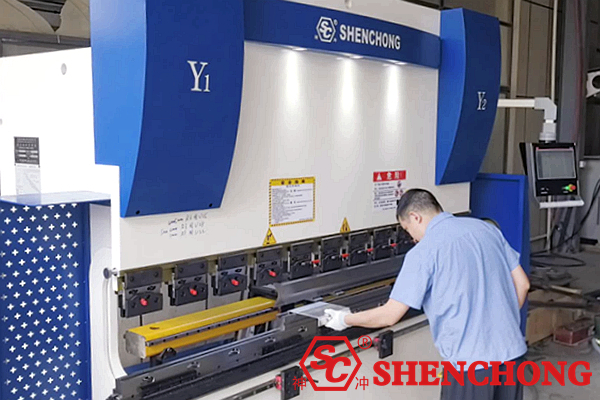
A key feature of the WSK series is that it is not a basic mechanical-synchronization or standard hydraulic press brake in the traditional sense; instead, it represents an evolution toward servo-hydraulic control.
Operational process:
CNC System → Servo Control → Hydraulic Power → Left & Right Cylinders → Ram Movement → Tooling Force Application → Sheet Metal Forming
Specifically:
The Y1 axis controls the position of the left cylinder.
The Y2 axis controls the position of the right cylinder.
Independent control of Y1 and Y2 allows for the compensation of positional discrepancies between the left and right sides caused by load, the workpiece material, and frame deformation.
Therefore, the synchronization control of Y1 and Y2 lies at the core of the press brake’s ram operation.
3. Control System
The 63T 2500 CNC press brake can be equipped with various CNC controllers depending on specific order requirements.
The unit in this example utilizes the ESA S630, a typical CNC control system for sheet metal bending.
The ESA S630 supports functions such as:
- Bending program editing
- Graphical programming
- Bending angle setting
- Automatic calculation of bending force
- Automatic calculation of developed length (blank length)
- Automatic backgauge positioning
- Multi-step bending programs
- Angle correction
- Compensation control
Shenchong current product line also offers other control options, such as the EL15T and EL19T, depending on the specific equipment configuration.
4. What thickness of sheet metal can a 63-ton press brake bend?
This is a key consideration when purchasing a 63T press brake.
It cannot be simply assumed that 63T means it can bend 6.3mm plate.
Actual bending capacity is determined by a combination of factors:
- Material
- Plate thickness
- Bending length
- V-die opening width
- Bending method
- Bending radius
- Bending line length
A practical guideline
For Q235 standard carbon steel:
A 63T x 2500 CNC press brake is generally well-suited for:
Processing thin to medium-thin sheet metal.
For example:
1.0 mm
1.5 mm
2.0 mm
2.5 mm
3.0 mm
4.0 mm
5.0 mm
These all fall within the typical application range.
However, for thicknesses exceeding 6mm, the 63T rating alone is insufficient; the required tonnage must be calculated based on the actual bending length and V-die opening width.
SC 63T 2500 CNC press brake for sale is a practical, mid-sized machine specification:
The 63-ton capacity handles thin to medium-thin plate bending, while the 2500mm working length accommodates a wide range of standard sheet metal parts; CNC Y1/Y2 synchronization and an automatic backgauge ensure precision and productivity.
It is particularly suitable for standard sheet metal processing in the 2 – 4mm range. If the primary application involves thicker stainless steel or long, heavy plates, the required tonnage must be recalculated based on the specific bending length, V-die opening, and material properties.
 English
 Spanish
 Portuguese
 Russian
 Arabic
 French
 Italian
 German
 Polish
 Thai
 Vietnamese
 Lithuanian
 Czech
 Korean
 Japanese
 Chinese