
Table of Contents
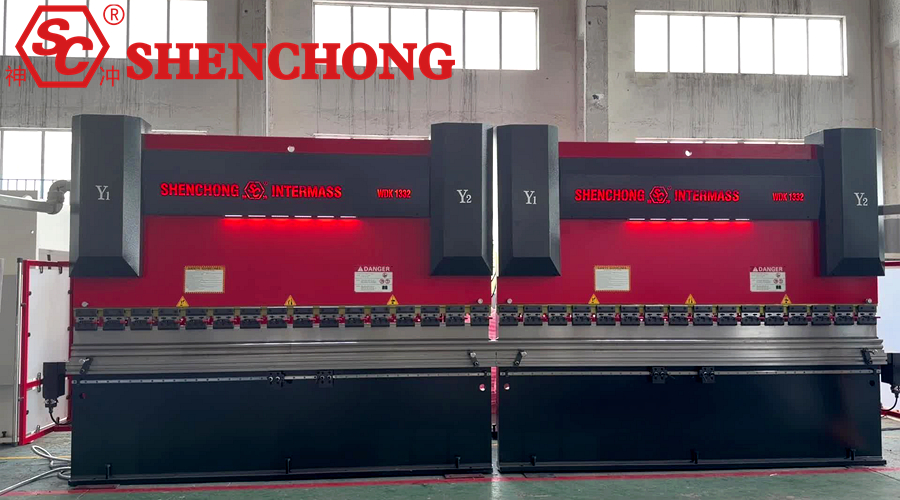
Heavy-duty tandem bending machine is essential processing equipment in industries such as large-scale sheet metal manufacturing, steel structure manufacturing, wind power equipment, shipbuilding, power poles, rail transportation, and construction machinery.
They achieve synchronous linkage control through two CNC press brake bending machines of the same or matched specifications, enabling the bending of ultra-long and ultra-thick sheets that cannot be processed by a single machine. They can also be split into two independent machines for use according to production needs. Therefore, they combine large-scale processing capacity with production flexibility.
1. What is a Heavy-Duty Tandem Bending Machine?
A heavy-duty tandem sheet metal bending machine refers to a heavy-duty sheet metal forming machine that uses two CNC press brakes of the same or similar specifications, working collaboratively through a linkage control system, a synchronous hydraulic system, and a mechanical connection structure to simultaneously bend extra-long sheets and extra-large workpieces.
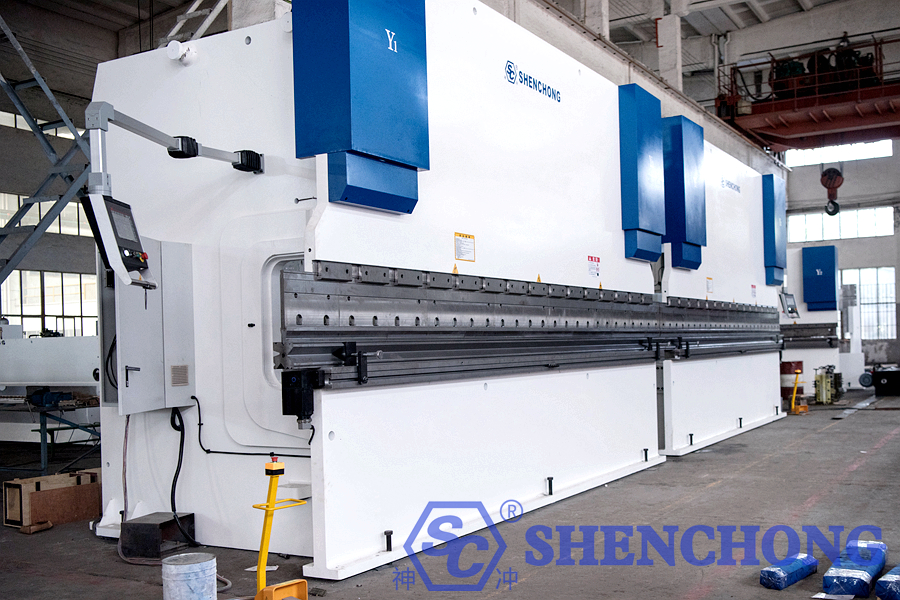
Its core value lies in two main characteristics: “linkage” and “heavy-duty”:
- Linkage:The two machines do not operate independently, but rather synchronously complete the slider movement, angle control, position control, and pressure distribution under unified control.
- Heavy-duty:Typically used for forming large-tonnage, long-length, and thick sheet metal, requiring high levels of machine rigidity, cylinder stability, control precision, and resistance to eccentric loads.
For example:
400T×6000 + 400T×6000
500T×7000 + 500T×7000
800T×8000 + 800T×8000
After linkage, it can achieve:
12 meters
14 meters
16 meters
18 meters
Over 20 meters
Extra-long workpieces can be bent in one go.
After delinking:
The two machines can be used as independent bending machines to process different parts, greatly improving equipment utilization.
This type of heavy-duty tandem bending machine is widely used in:
- Steel structure industry
- Construction machinery industry
- Electrical cabinets
- Rail transit
- Shipbuilding
- Environmental protection equipment
- Tanks, boxes, large shells
- Large door panels, bridge accessories, wind power auxiliary structural components, etc.
2. Working Principle Of Tandem Press Brake
1) Synchronous Control Principle
The core of the entire dual-machine linkage is:
The two bending machines must move synchronously as if they were one machine.
Synchronization includes:
- Left machine Y-axis
- Right machine Y-axis
- Stroke
- Pressure
- Speed
- Holding time
- Return speed
- Back gauge position
All actions must be consistent in real time.
Modern equipment commonly uses:
Electro-hydraulic servo closed-loop synchronous control
Heavy-Duty Tandem Bending Machine Workflow:
① CNC system sends commands
↓
② Two servo proportional valves move synchronously
↓
③ Left and right cylinders descend synchronously
↓
④ Linear ruler provides real-time position feedback
↓
⑤ CNC corrects errors in real time
↓
⑥ Maintains minimal synchronization error
The entire synchronization process is automatically completed by the control system.
2) Closed-Loop Feedback System
Main components include:
- Linear ruler
- Displacement sensor
- Servo proportional valve
- CNC controller
- PLC communication module
Formation:
Command → Execution → Detection → Correction
Closed-loop control.
Even if:
the loads on the left and right cylinders are different,
the workpiece weights are different,
the mold wear is different,
the system will correct in real time.
3) Linkage Communication
Currently, the following are generally used:
- EtherCAT
- CAN Bus
- ProfiNet
- EtherNet/IP
High-speed communication.
Guarantee:
Extremely low latency between the two devices.
3. Equipment Composition
A complete heavy-duty tandem bending machine typically includes:
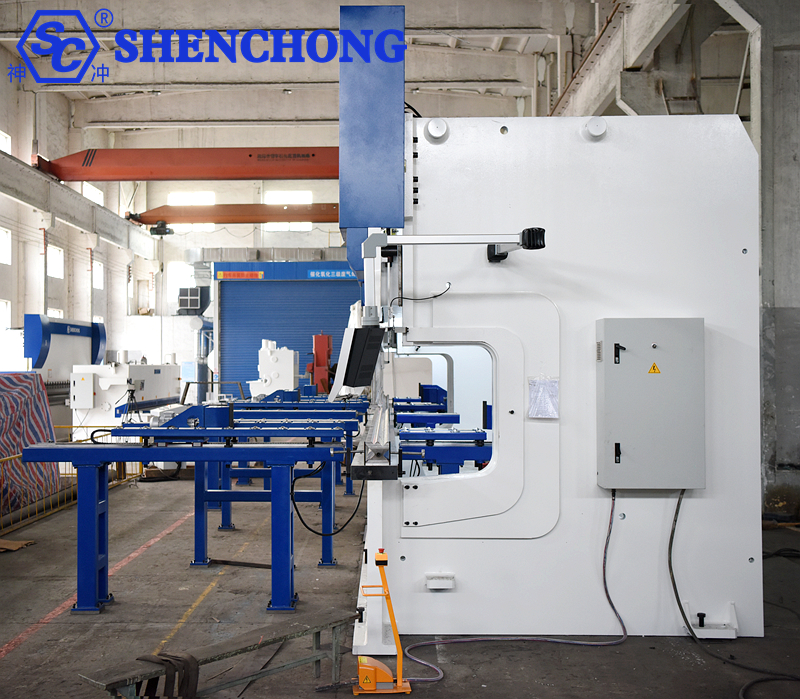
1) Main Unit
Two heavy-duty bending machines
Includes:
- Frame
- Slider
- Worktable
- Hydraulic cylinder
CNC system
Generally uses:
- ESA
- Delem
- Cybelec
- SC EL
Supports:
- Dual-machine linkage mode
2) Electro-hydraulic Synchronization System
Includes:
- Proportional valve
- Servo valve
- Linear ruler
- Encoder
Achieving synchronous control.
3) Hydraulic System
Includes:
- Oil tank
- Hydraulic pump
- Motor
- Valve block
- Cooling system
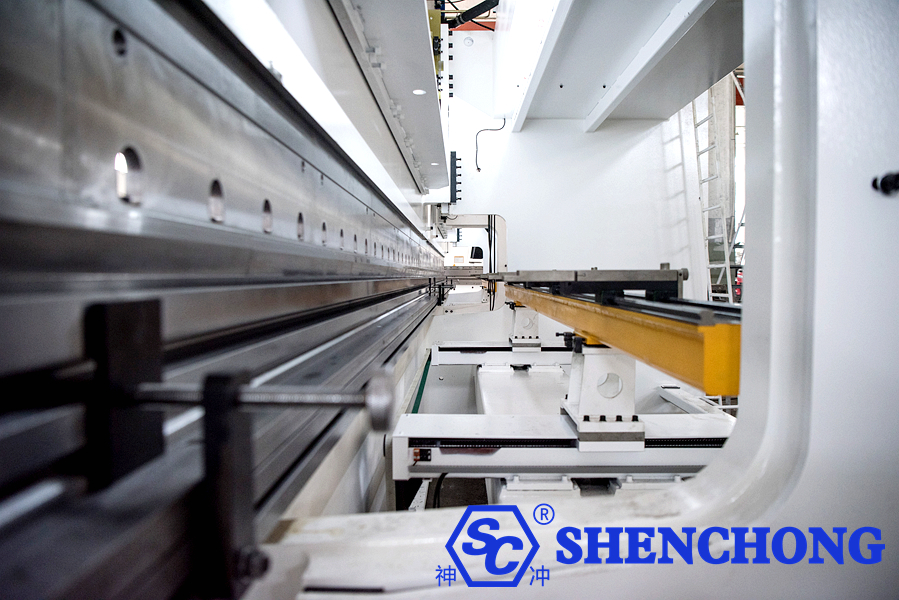
- Back gauge system
Configurable:
- X-axis
- R-axis
- Z1/Z2 axis
High-end equipment can achieve multi-axis linkage.
4) Deflection Compensation System
Mainly used for:
Eliminating worktable deformation under stress.
Improving the angle consistency of the entire bending line.
4. Features of Heavy-Duty Tandem Press Brake
1) Extra-long Processing Capacity
Ordinary Bending Machine:
Typically processes lengths of 2-6 meters.
Dual-Machine Linkage:
Can process:
10 meters
12 meters
14 meters
Over 16 meters
Large workpieces.
For example:
- Wind turbine towers
- Power poles
- Streetlight poles
- Ship hull plates
- Bridge components
2) Extra-large Tonnage
Tonnage is superimposed after linkage.
For example:
Two 400T machines
After linkage:
Approximately 800T of synchronous processing capacity can be achieved.
Suitable for:
- Thick steel plates
- High-strength steel
- Wear-resistant steel
- Large structural components
3) High Synchronization Precision
Modern electro-hydraulic synchronization systems can maintain coordinated operation of the two machines. Combined with grating ruler feedback and automatic compensation, it can significantly reduce the angle difference and position error when bending long workpieces.
4) Independent + Linkage Dual Mode
This is the biggest advantage.
It can:
Dual-machine linkage.
It can also:
Two machines can operate independently.
Equipment utilization is significantly improved.
5) Automatic compensation
Uses:
CNC hydraulic compensation
or
Mechanical compensation
Ensures:
Consistent bending angles for long workpieces.
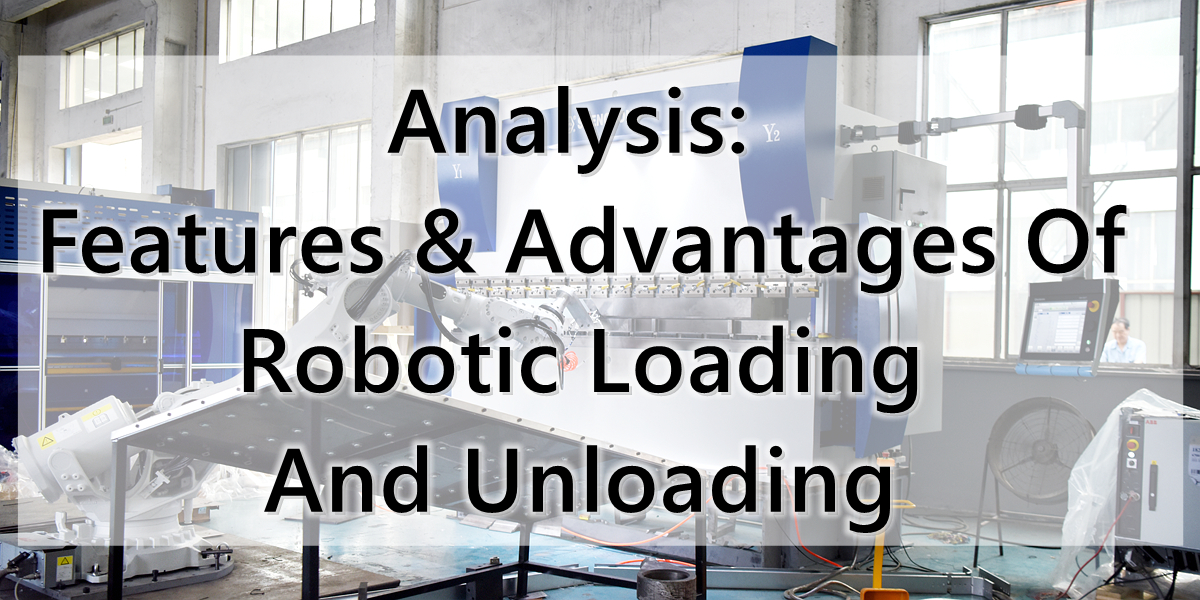
6) High degree of automation
Can be equipped with:
- Automatic loading and unloading
- Vacuum suction cups
- Follow-up material handling
- Six-axis robot
- AGV transportation
- MES system
Achieving intelligent production.
5. Core Strengths Analysis
Strengths Analysis Table:
Advantages | Description |
Extra-long bending | Completes bending of workpieces over 10 meters in a single operation |
High efficiency | Reduces segmented processing and repetitive positioning |
High precision | Dual-machine synchronous control ensures excellent angle consistency |
High flexibility | Switchable between linked and stand-alone modes |
Automation | Easy to integrate with robots and smart production lines |
High return on investment | One system covers a wider range of processing scenarios |
From an investment perspective, although the initial investment in this type of equipment is relatively high, it has strong comprehensive value in large-scale processing scenarios:
- It reduces segmented splicing and secondary corrections.
- Increases production cycle time.
- Reduces manual handling.
- Improves the first-pass yield of large parts.
- Suitable for the production of high-value-added large workpieces.
For companies with stable large-part orders, heavy-duty tandem bending machine is often not “dispensable,” but rather an important piece of equipment for increasing production capacity and expanding business boundaries.
6. Typical Application Industries
Mainly used in:
- Steel structure manufacturing
- Power poles and towers
- Wind turbine towers
- Shipbuilding
- Port machinery
- Construction machinery
- Container manufacturing
- New energy equipment
- Railway vehicles
- Large pressure vessels
- Heavy sheet metal manufacturing
- Bridge engineering
- Building curtain walls
- Streetlight pole production
- Elevator manufacturing
7. Procurement Guidelines
When purchasing this type of equipment, it’s crucial to consider more than just “tonnage” and “length.” System compatibility and long-term stability are paramount. The following dimensions are critical:
1) Matching Actual Processing Needs
First, clarify the following:
- Maximum plate length
- What is the thickest material?
- Is the commonly used material carbon steel, stainless steel, or aluminum?
- Is it a single long bend or multiple complex bends?
- Is high-precision angle consistency required?
- Do you frequently process large batches of workpieces?
These directly determine your required tonnage, worktable length, and control system.
2) Linkage Accuracy and Synchronization Control Capability
The core of dual-machine linkage is synchronization accuracy. Key points to confirm during procurement:
- Synchronization error control level of the two machines
- Whether closed-loop detection is supported
- Whether automatic deviation compensation is available
- Stability during long-term operation
- Whether accuracy remains consistent during repeated bending
3) Frame rigidity and overall stability
If the frame of heavy equipment is not rigid enough, it is prone to the following problems after long-term use:
- Slider deflection
- Machine body deformation
- Inconsistent left and right angles
- Accuracy reduction
Therefore, the machine body material, welding process, heat treatment, and precision machining capabilities are all very important.
4) Hydraulic system quality
The hydraulic system affects:
- Operating smoothness
- Noise
- Heat generation
- Synchronization response speed
- Failure rate
Recommended considerations:
- What type of hydraulic valve group is used
- Is there oil temperature control?
- Is the filtration system adequate?
- The brand and lifespan of the seals
- Continuous heavy load capacity
5) Ease of use of the CNC system
For factories, the system must not only be accurate but also easy to use.
Key aspects to consider:
- Is the program easy to edit?
- Does it support graphical bending programming?
- Is parameter storage sufficient?
- Is the linkage control intelligent?
- Does it support angle compensation and automatic correction?
6) Back gauge accuracy
The back gauge determines the accuracy of the workpiece bending dimensions.
Key aspects to consider:
- Repeatability
- Movement speed
- Stability
- Multi-axis configuration capability
7) Die configuration capability
Heavy equipment often requires stronger die adaptability.
Key considerations:
- Availability of standard molds
- Support for customized molds
- Ease of quick mold replacement
- Mold wear resistance
8) After-sales service and spare parts supply
This type of equipment is capital-intensive, making after-sales service crucial:
- Can on-site service be provided quickly?
- Is the control system easy to maintain?
- Are spare parts such as hydraulic components, sensors, and linear scales complete?
- Is installation, commissioning, and training provided?
9) Completeness of safety features
Heavy-duty linkage bending machines have high safety risks.
When purchasing, pay attention to:
- Two-hand operation safety devices
- Photoelectric protection
- Emergency stop system
- Anomalous linkage protection
- Misoperation protection
- Mold installation safety design
Common misconceptions during procurement:
– Focusing only on tonnage, ignoring process
Large tonnage does not equate to suitability for all workpieces. Different materials, lengths, and bending methods require different tonnage.
– Focusing only on length, ignoring synchronization accuracy
Extra-long does not guarantee good bending performance. Synchronization accuracy is key for dual-machine linkage; otherwise, long parts are prone to inconsistencies at both ends.
– Underestimating workpiece springback
Especially for materials like stainless steel and high-strength steel, springback is significant, requiring equipment and systems with better angle compensation capabilities.
– Ignoring foundation installation conditions
Heavy-duty dual-machine linkage equipment has high requirements for foundation, levelness, and spatial layout. A poor foundation will negatively impact accuracy and lifespan in the long run.
– Ignoring operator skill levels
Even the best equipment will struggle to perform optimally if operation, programming, and die selection are inadequate.
Purchasing decision recommendations:
If your orders primarily consist of small to medium-sized parts, with occasional extra-long parts, dual-machine linkage is generally more cost-effective than a single extra-large bending machine.
If you consistently produce extra-long, extra-heavy, and extra-thick workpieces, you should further evaluate the rigidity, automation level, and specialization of the linkage line.
Also note: Larger tonnage is not always better. The true determinant of finished product quality is “reasonable tonnage + suitable dies + correct process parameters + stable synchronization.”
Within the same product range, choosing a mature control system, reliable synchronization mechanism, and comprehensive service system is often more important than simply pursuing larger specifications.
8. Routine Maintenance
It is recommended to establish a standardized maintenance system:
Cycle | Maintenance Contents |
Per shift | Check hydraulic oil level, clean equipment, and check safety devices |
Weekly | Check lubrication points, guide rails, lead screws, fasteners, and synchronization status |
Monthly | Check for hydraulic system leaks and verify the accuracy of the linear encoder and back gauge |
Quarterly | Check oil contamination, filters, cooling system, and electrical wiring |
Yearly | Replace hydraulic oil (according to operating conditions) and perform a full calibration of synchronization and geometric accuracy |
Meanwhile, we should avoid overloading, regularly check mold wear, and maintain lubrication of guide rails and lead screws. Periodic calibration of the synchronization and compensation systems is also necessary to ensure long-term stable accuracy.
9. Common Faults and Troubleshooting
1) Two machines are out of sync
Possible causes:
- Incorrect linkage parameters
- Sensor malfunction
- Hydraulic system imbalance
- Unstable communication signal
Troubleshooting:
- Recalibrate synchronization parameters
- Check feedback device
- Check oil pressure and valve group status
- Test linkage communication
2) Inconsistent bending angles
Possible causes:
- Inconsistent pressure between left and right cylinders
- Frame or slider deviation
- Uneven material thickness
- Die wear
Troubleshooting:
- Correct pressure and stroke
- Recheck levelness
- Replace or repair die
- Perform trial bending compensation
3) Inaccurate back gauge positioning
Possible causes:
- Weared lead screw
- Loose transmission
- Encoder malfunction
- Parameter drift
Troubleshooting:
- Check mechanical clearance
- Re-zero
- Inspect motor and encoder
- Perform positioning accuracy verification
4) Hydraulic system overheating
Possible causes:
- Continuous high load operation
- Oil contamination
- Insufficient cooling capacity
- Excessive valve group resistance
Troubleshooting:
- Control continuous operation cycle
- Change oil filter in time
- Check cooling device
- Clear oil circuit blockages
10. Summary
The heavy-duty double-machine linkage sheet metal bending machine is a highly representative high-end equipment in the field of large-scale sheet metal processing. Through the synchronous collaboration of two machines, it overcomes the limitations of single-machine length and tonnage, achieving high-precision bending processing of ultra-long, ultra-heavy, and ultra-large sheet metal.
Its core advantages can be summarized as:
- It can process longer, heavier, and thicker sheet metal
- Better bending consistency
- Higher production efficiency
- Adaptability to complex working conditions in heavy industry
- Extremely high value for processing large structural components
However, at the same time, it places high demands on:
- Equipment rigidity
- Synchronization accuracy
- Hydraulic system
- Control system
- Installation foundation
- Operator skill level
- Daily maintenance and management
Therefore, when purchasing and using it, one should not only consider price and tonnage, but also comprehensively examine the equipment quality, process adaptability, and service support capabilities.
The heavy-duty tandem bending machine not only solves the processing problem of ultra-long and ultra-thick sheet metal in one step, but also meets the production needs of high precision, high efficiency, and high flexibility. With its dual-machine linkage and independent single-machine switching, advanced electro-hydraulic servo synchronous control, automatic compensation, and excellent automation expansion capabilities, it has become an important piece of equipment for large sheet metal manufacturing and heavy equipment manufacturing enterprises to improve production capacity and reduce overall costs. Proper equipment selection, standardized maintenance, and integration with automated production lines can further enhance its value in intelligent manufacturing.
 English
  Spanish
  Portuguese
  Russian
  Arabic
  French
  Italian
  German
  Polish
  Thai
Thai  Vietnamese
  Lithuanian
  Czech
Czech  Japanese
  Chinese