
Table of Contents
As the sheet metal processing industry develops towards intelligence, automation, and flexibility, laser cutting loading unloading systems have become an important component of modern metal processing production lines.
As the sheet metal processing industry develops towards intelligence, automation, and flexibility, laser cutting loading unloading systems have become an important component of modern metal processing production lines.
Automated loading and unloading systems, through equipment such as vacuum suction cups, robotic arms, gantry cranes, lifting platforms, automatic sheet separation devices, intelligent control systems, and automated warehousing, achieve automated operation of sheet metal from raw material storage, automatic picking, precise positioning, laser cutting, to finished product unloading.
Automated loading and unloading systems, through equipment such as vacuum suction cups, robotic arms, gantry cranes, lifting platforms, automatic sheet separation devices, intelligent control systems, and automated warehousing, achieve automated operation of sheet metal from raw material storage, automatic picking, precise positioning, laser cutting, to finished product unloading.
1. What is A Laser Cutting Loading Unloading System?
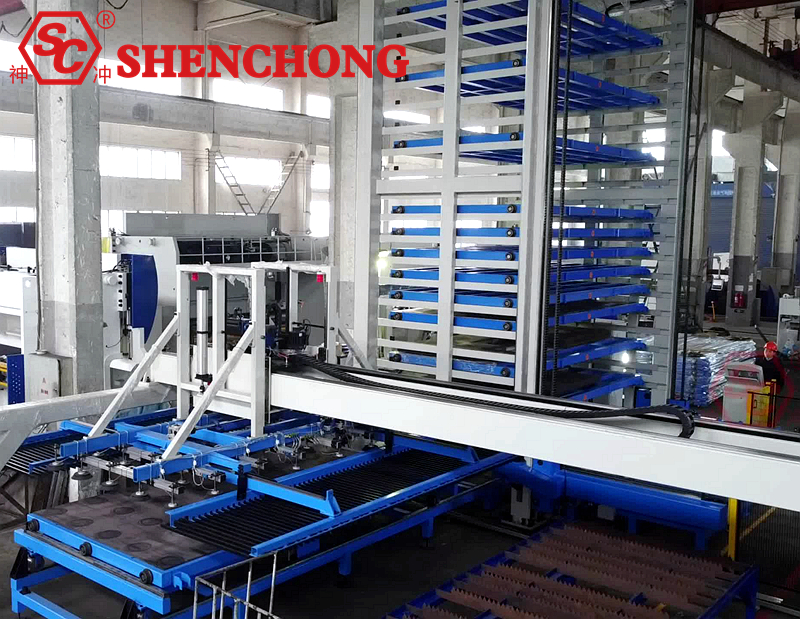
An automatic loading and unloading system for laser cutting is a sheet metal automation auxiliary equipment integrating mechanical automation, intelligent control, sheet metal handling, automatic positioning, finished product unloading, and production management.
This system is mainly used with fiber laser cutting machines. Through vacuum suction cups, robotic arms, gantry cranes, lifting platforms, fork-tooth separation devices, and an intelligent control system, it achieves automatic loading of raw material sheets, automatic unloading after cutting, and collaborative operation with intelligent warehousing systems.
Compared to traditional manual loading and unloading methods, automated loading and unloading systems reduce manual handling, shorten non-cutting auxiliary time, improve equipment utilization, and provide a foundation for flexible, continuous, and intelligent production in sheet metal factories.
For industries such as automotive parts, chassis and cabinets, electrical equipment, construction machinery, elevator manufacturing, stainless steel products, and metal furniture, automated loading and unloading systems are not only auxiliary equipment for improving production efficiency but also an important component in building intelligent sheet metal production lines.
2. Composition And Structure of Automated laser cutting loading unloading systems
A complete automated loading and unloading system typically consists of the following core modules.
Core Components | Main Functions | Technical Features |
Automatic Feeding Mechanism | Grab sheet metal from the raw material area and deliver it to the cutting table. | Vacuum suction cups, gantry trusses, servo drives |
Automatic Unloading Mechanism | Transfer cut sheet metal or workpieces to a designated area. | Fork-tooth, tray, robotic arm, etc. |
Vacuum Adsorption System | Adhere to and stably transport metal sheets. | Zoned adsorption, vacuum detection |
Sheet Separating Device | Reduce the risk of simultaneously picking up multiple sheets. | Magnetic sheet separation, air-blowing sheet separation, double sheet detection |
Automatic Positioning Device | Ensure the correct position of the sheet metal on the cutting table. | Mechanical positioning, sensor detection |
Lifting Platform | Store and lift sheets to be processed. | Hydraulic or electric lifting |
Servo Drive System | Control the movement of the loading and unloading mechanisms. | Servo motors, rack and pinion, or linear guides |
PLC Control System | Coordinate equipment actions and interlocks. | Automatic cycle, fault alarm, status monitoring |
Safety Protection System | Prevent personnel from entering hazardous movement areas. | Safety fences, light curtains, emergency stop, interlocks |
Intelligent Storage Interface | Connect the sheet metal storage area to the production line. | Automatic inbound/outbound, task scheduling |
It’s important to note that the actual configurations vary between systems from different manufacturers and at different levels of automation. For example, a basic loading and unloading system might only be equipped with a single suction cup gantry and lifting platform, while a large flexible production line might integrate multi-layer material storage, automatic sorting, AGV/AMR logistics, and an MES system.
3. Working Principle of Laser Cutting Loading/Unloading Systems
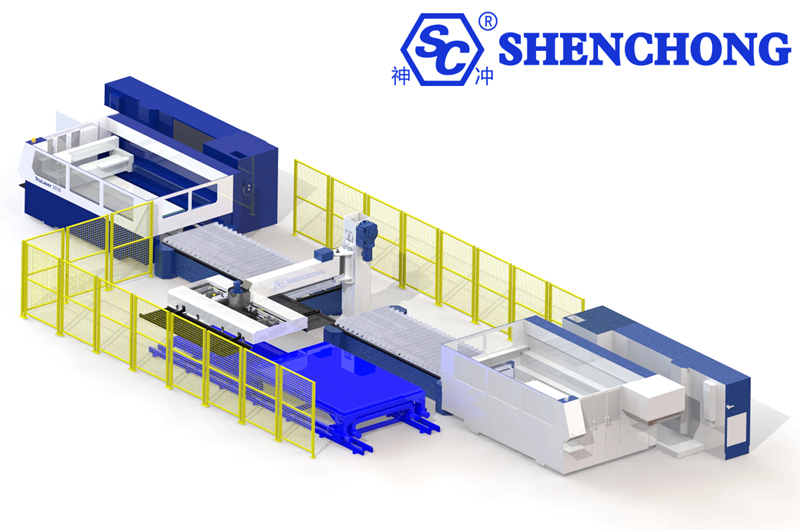
Typical Automatic Loading and Unloading Process:
- Raw Material Storage Area/Intelligent Material Storage: Sheet material preparation and task scheduling
- Automatic Sheet Separation and Vacuum Adsorption: Single sheet detection and stable gripping
- Gantry Automatic Loading and Positioning: Sending the sheet material to the cutting worktable
- Fiber Laser Cutting: Completing sheet material processing according to the program
- Automatic Unloading and Transfer: Unloading whole sheets, frames, or parts
- Classification and Stacking/Next Process: Finished product transfer and production data recording
Specific Working Process:
- Automatic Material Preparation: The operator selects the cutting program, sheet material specifications, and production quantity in the control system, and the system confirms that the raw materials are ready.
- Automatic Sheet Separation: The loading mechanism moves to the raw material area and grips single sheets of sheet material using the sheet separation device, vacuum suction cup, and dual-sheet detection mechanism.
- Automated Conveying: Servo-driven gantry moves the sheet metal to the laser cutting machine’s exchange table or designated loading position.
- Automatic Positioning: Mechanical positioning or sensors confirm the sheet metal’s position, preventing offset, collisions, and duplicate loading.
- Laser Cutting: The laser cutting machine processes the metal sheet metal according to a preset program.
- Automatic Unloading: Based on the equipment structure, the cut whole sheet, framed workpieces, or separated parts are unloaded to a designated area.
- Circular Production: The system coordinates loading/unloading with the cutting machine’s operation to achieve continuous batch processing.
- Important Note: Standard automatic unloading is not the same as automatic parts sorting. If parts of different shapes and sizes need to be stacked separately, vision recognition, robotic sorting, or a dedicated parts sorting module is usually required.
4. Ten Core Advantages of an Automated Laser Cutting Loading/Unloading System
Advantage 1: Significantly Improved Production Efficiency
Automatically completes sheet metal gripping, conveying, positioning, and unloading, reducing manual handling and waiting time. Combined with the exchange table, some loading/unloading actions can be performed concurrently with the cutting process, reducing non-productive time.
Advantage 2: Reduced Labor Intensity
Reduces the workload of manually handling large, heavy, and sharp-edged sheets. Operators can focus more on equipment monitoring, quality inspection, and production management.
Advantage 3: Increased Equipment Utilization
Automatic material preparation, automatic cycling, and task scheduling reduce downtime of cutting machines caused by untimely manual material supply, making it particularly suitable for high-volume and multi-shift production.
Advantage 4: Improved Sheet Handling Stability
Multi-point vacuum adsorption, zoned control, mechanical positioning, and vacuum pressure detection help reduce sheet slippage, scratches, and positional deviations during handling.
Advantage 5: Optimized Workshop Space Utilization
Combined with an automated material storage system, it enables multi-layer centralized storage of sheets, reducing some planar stacking area and making raw material management more organized.
Advantage 6: Improved Operational Safety
Reduces the frequency of direct contact between personnel and heavy sheets and dangerous moving mechanisms, and mitigates risks through safety fences, interlocks, and light curtains.
Advantage 7: Supports Multi-Specification Sheet Material Processing
Within the limits of suction cup layout, effective load, and equipment stroke, it can adapt to sheets of different sizes, thicknesses, and materials.
Advantage 8: Supports Continuous Batch Production
In conjunction with a material warehouse and task management system, it can conduct long-term automated production when material availability, waste disposal, and safety monitoring conditions are met.
Advantage 9: Reduces Overall Manufacturing Costs
By reducing manual handling time, increasing equipment utilization, and improving logistics efficiency, it reduces the overall production cost per unit product.
Advantage 10: Facilitates Digital Upgrades
It can connect with MES, ERP, WMS, and production scheduling systems to achieve production task management, material tracking, and equipment status monitoring.
5. Six Key Technical Features of the Automated Loading and Unloading System
1) Vacuum Suction Cup Automated Loading
Vacuum adsorption technology is one of the core technologies commonly found in automated sheet material loading systems.
Key features include:
- Employs a multi-point suction cup structure to distribute the load-bearing force of the sheet material.
- Selects an appropriate adsorption area based on the sheet material size.
- Confirms the gripping status through vacuum detection.
- For large-format thin plates, a well-designed suction cup layout can reduce deflection.
- Combining air blowing, magnetic separation, and double-sheet detection technologies can improve material handling reliability.
For different materials such as stainless steel, aluminum, and carbon steel, the suction cup material and quantity should be selected based on the surface condition, thickness, weight, and rigidity of the plate. Perforated plates, oil-stained plates, and plates with uneven surfaces may require special adsorption solutions.
2) High-rigidity gantry truss structure
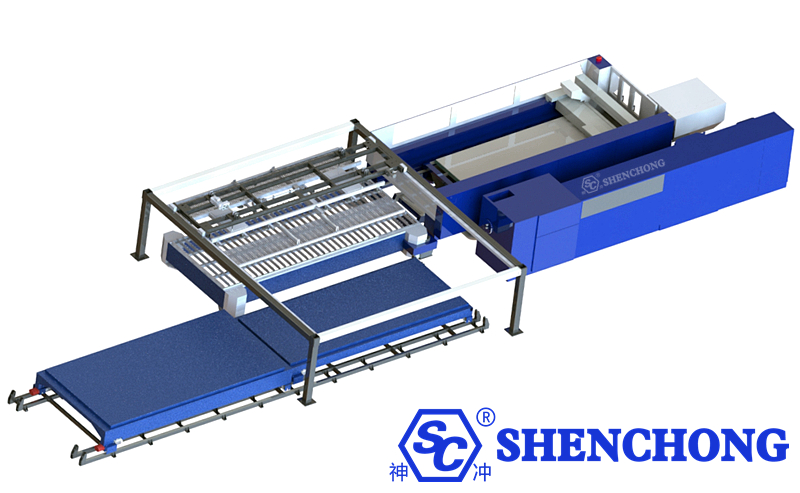
Gantry trusses typically employ a steel frame structure, linear guides, servo drives, and rack and pinion transmissions.
Its main features are controllable running trajectory, large coverage area, and structural stability, making it suitable for 3015, 4020, 6020, and other laser cutting machines.
For large-format plates, special attention needs to be paid to beam rigidity, running speed, acceleration/deceleration control, and positioning accuracy under load.
3) Intelligent double-sheet detection technology
During automatic feeding, two thin plates may be simultaneously lifted due to oil film, static electricity, or surface adhesion.
The dual-sheet inspection system reduces the risk of multiple sheet loading through thickness detection, sensor judgment, and the coordination of the sheet-separating mechanism.
This function is particularly important for thin sheets, high surface quality sheets, and continuous automated production.
4) Automatic Unloading and Classification Management
Automatic unloading methods can be divided into the following categories.
Unloading methods | Key Features | Applicable Scenarios |
Automatic unloading of entire pallets | Unloads the cut sheet metal along with its frame. | Conventional sheet metal processing |
Forklift unloading | The sheet metal or frame is supported by forks. | Large-format sheet metal |
Pallet exchange unloading | The exchange table and transfer mechanism work together to grab and sort the individual cut parts. | Continuous batch cutting |
Robot sorting | The parts are grabbed based on part identification and location information. | Multi-variety parts production |
Visual intelligent sorting | Unloads the cut sheet metal along with its frame. | Flexible automated production |
For high-precision parts sorting, special attention should be paid to whether the cut parts have been completely separated from the frame, and whether there are any warping, overlaps, or micro-connections.
5) PLC Intelligent Control and Equipment Linkage
The PLC control system can coordinate the laser cutting machine, loading and unloading mechanisms, lifting platforms, and storage equipment.
Main functions include automatic cycling, action interlocking, fault alarms, sheet metal detection, equipment status display, and operation records.
Through communication with the laser cutting machine control system, it can also achieve functions such as receiving cutting completion signals, confirming the status of the exchange platform, and initiating automatic loading and unloading tasks.
6) Modular Structure And Flexible Expansion
Modular design allows the automatic loading and unloading system to be upgraded gradually according to production scale.
- Automation System Upgrade Path: Basic Automated Loading and Unloading: Single laser cutting machine + Loading/Unloading gantry + Raw material table
- Continuous Production System: Automated loading and unloading + Exchange table + Multi-position material handling
- Intelligent Warehouse Integration System: Automated loading and unloading + Multi-level material storage + Inventory Management
- Intelligent Flexible Sheet Metal Production Line: Material storage + Multiple laser cutting machines + Automated sorting + MES
6. Comparison of Automated Loading and Unloading with Traditional Manual Loading And Unloading
Comparison Items | Manual loading and unloading | Automated loading and unloading |
Feeding Method | Manual handling or assisted hoisting | Suction cup and gantry automated handling |
Labor Requirements | Requires continuous participation | Primarily for monitoring and replenishment |
Work Continuity | Affected by staffing arrangements | Capable of continuous cycling |
Positioning Consistency | Affected by operational experience | Repeatedly positioned according to program |
Heavy Plate Handling | Usually requires crane assistance | Automatically handles loads according to rated capacity |
Safety | Many personnel handle sheet materials | Reduces manual operation in hazardous areas |
Multi-Shift Production | Dependent on staffing levels | Easier to organize multi-shift operations |
Initial Investment | Relatively low cost | Relatively high cost |
Equipment Maintenance | Relatively simple | Requires maintenance of electrical and mechanical systems |
Expansion Capability | Limited | Can be integrated with material storage and production management systems |
Automation is not always an absolute advantage. For factories with small batch sizes, frequent changes in sheet material types, and low cutting machine utilization, the first step should be to assess the investment in equipment versus the actual labor time saved, avoiding prolonged idleness of automated equipment.
7. Key Technical Parameters of Automated Loading and Unloading Systems
The following uses a gantry-type loading and unloading system with a 3015 specification laser cutting machine as an example to list common technical parameters for selection. The ranges in the table are for reference only in scheme design and should not be considered as the factory technical specifications for specific products.
Technical Parameters | Reference Configuration or Selection Guide |
Compatible Cutting Machines | 3015 Fiber Laser Cutting Machine |
Nominal Sheet Size | 3000 × 1500 mm |
Applicable Sheet Material | Carbon steel, stainless steel, aluminum plate, etc. |
Rated Load for Feeding | Select according to plate weight, such as 300–1000 kg class |
Feeding Mechanism | Gantry type |
Gripping Method | Vacuum suction cup type |
Transmission Method | Servo motor, gear rack or other mechanism |
Positioning Method | Mechanical positioning, sensor detection |
Sheet Separation Function | Configuration according to requirements |
Double Sheet Detection | Recommended configuration |
Unloading Method | Fork type, tray type or other solutions |
Control System | PLC + HMI |
Operating Mode | Manual, semi-automatic, fully automatic |
Table Type | Fixed platform or lifting platform |
Storage Interface | Optional intelligent material storage interface |
Safety Configuration | Fence, emergency stop, safety interlock and protection detection |
For example, a standard carbon steel plate measuring 3000 × 1500 × 6 mm, with a density of 7850 kg/m³:
m = 3.0 × 1.5 × 0.006 × 7850
m ≈ 211.95 kg
Therefore, when selecting a feeding system, it is necessary to consider not only the weight of a single sheet of steel but also the weight of the suction cups and grippers, eccentric loads, acceleration and deceleration dynamic loads, and necessary safety margins.
8. Main Application Industries of Automated Loading Unloading Systems
- Electrical Cabinet Industry: Used for batch cutting of sheet metal for control cabinets, distribution cabinets, and communication cabinets.
- Automotive Parts Industry: Suitable for the production of automotive brackets, metal structural parts, and batch parts.
- Stainless Steel Products Industry: Reduces manual handling of sheet metal and improves processing logistics efficiency.
- Construction Machinery Industry: Suitable for automated handling of large-sized and heavy sheet metal.
- Elevator Manufacturing Industry: Suitable for processing sheet metal for elevator door panels, car structural parts, etc.
- Metal Furniture Industry: Supports the cutting and production of multiple batches of metal parts of different specifications.
9. How to Choose Suitable Automated Loading and Unloading System for Laser Cutting?
When selecting a system, factors such as sheet metal size and weight, production cycle time, workshop layout, and future automation expansion should be considered comprehensively.
System Types | Main Configuration | Recommend User |
Economy Type | Single cutting machine + basic material feeding mechanism | Small and medium-sized sheet metal processing plants |
Standard Type | Automatic feeding + automatic unloading + dual material tables | Medium-batch production enterprises |
High-Efficiency Type | Dual-station loading and unloading + exchange table + automatic scheduling | Multi-shift batch production enterprises |
Intelligent Warehousing Type | Automatic loading and unloading + multi-layer board material library | Multi-specification sheet metal production enterprises |
Flexible Production Line Type | Intelligent material library + multiple laser machines + automatic sorting + MES | Large-scale intelligent sheet metal factories |
Seven Key Considerations for Laser Cutting Machine Selection:
- Sheet Metal Specifications: Maximum and minimum sheet metal dimensions, thickness, and weight.
- Equipment Compatibility: Laser cutting machine brand, worktable type, interface protocol, and available space.
- Loading/Unloading Cycle Time: Loading and unloading time per sheet, and whether parallel operation is possible.
- Material Characteristics: Surface coating, oil stains, openings, deformation, and adhesion of thin sheets.
- Unloading Requirements: Unloading only whole sheets, or is automated parts sorting and palletizing required?
- Safety and Maintenance: Risk assessment, equipment interlocks, vacuum failure protection, and maintenance space.
- Future Expansion: Whether connection to an automated storage and retrieval system (AS/RS), AGV, MES, or multiple laser cutting machines is required.
10. Future Development Directions of Automated Loading and Unloading Systems for Laser Cutting
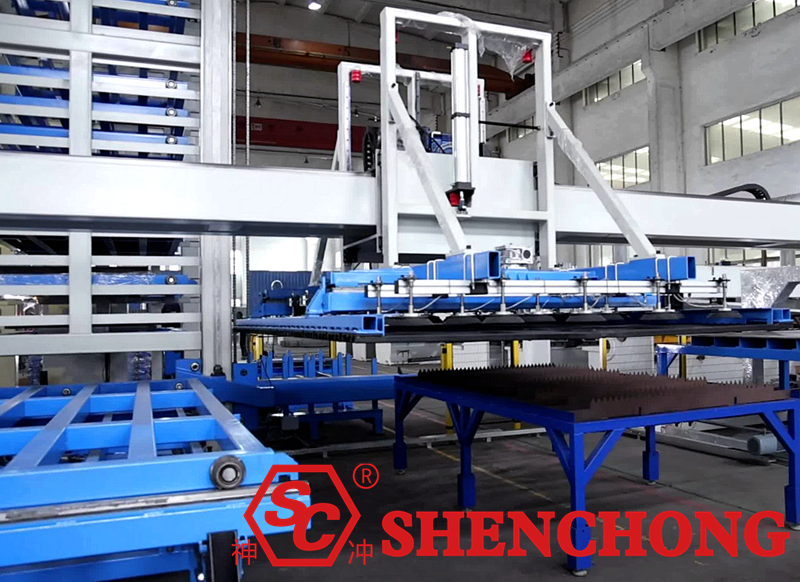
As the sheet metal manufacturing industry evolves towards intelligence, flexibility, and digitalization, automated laser cutting loading unloading systems are evolving in the following directions:
1) Integrated Intelligent Warehousing
Combining multi-layer sheet material warehouses with automated loading and unloading systems to achieve integrated management of raw material storage, automated warehousing, laser cutting, and waste material return.
2) Collaborative Production of Multiple Laser Cutting Machines
Through a central scheduling system, an intelligent warehousing and logistics system is connected to multiple laser cutting machines, allocating sheet metal according to production tasks.
3) Automated Parts Identification and Sorting
Combining visual recognition, robotic gripping, and workpiece classification technologies to reduce manual disassembly and sorting work after cutting.
4) Real-time Production Data Monitoring
Collecting data such as equipment operation, production progress, processing quantity, and fault records through industrial communication and MES systems.
5) Flexible Manufacturing and Automated Scheduling
Combining production orders, sheet metal inventory, cutting programs, and equipment status to achieve more flexible scheduling of multi-variety, small-batch production.
11. Summary
The core value of automated laser cutting loading unloading systems lies not only in replacing manual handling, but also in improving production continuity, equipment utilization, and production management efficiency through the deep integration of automated logistics and laser cutting technology.
For small and medium-sized sheet metal processing enterprises, standard automated loading and unloading systems can effectively reduce auxiliary operation time. For large manufacturing enterprises, the integration of automated loading and unloading with intelligent material storage, automated sorting, and MES systems can further build a complete intelligent flexible sheet metal production line.
Core Product Positioning: High-efficiency loading and unloading, intelligent control, flexible production, automated logistics, and digital management.
From single-machine automated loading and unloading to intelligent production lines with multiple laser cutting machines operating in tandem, automated laser cutting loading unloading systems are becoming crucial equipment for modern sheet metal manufacturing enterprises to enhance production capacity and promote intelligent manufacturing.
 English
 Spanish
 Portuguese
 Russian
 Arabic
 French
 Italian
 German
 Polish
 Thai
 Vietnamese
 Lithuanian
 Czech
 Korean
 Japanese
 Chinese