
Table of Contents
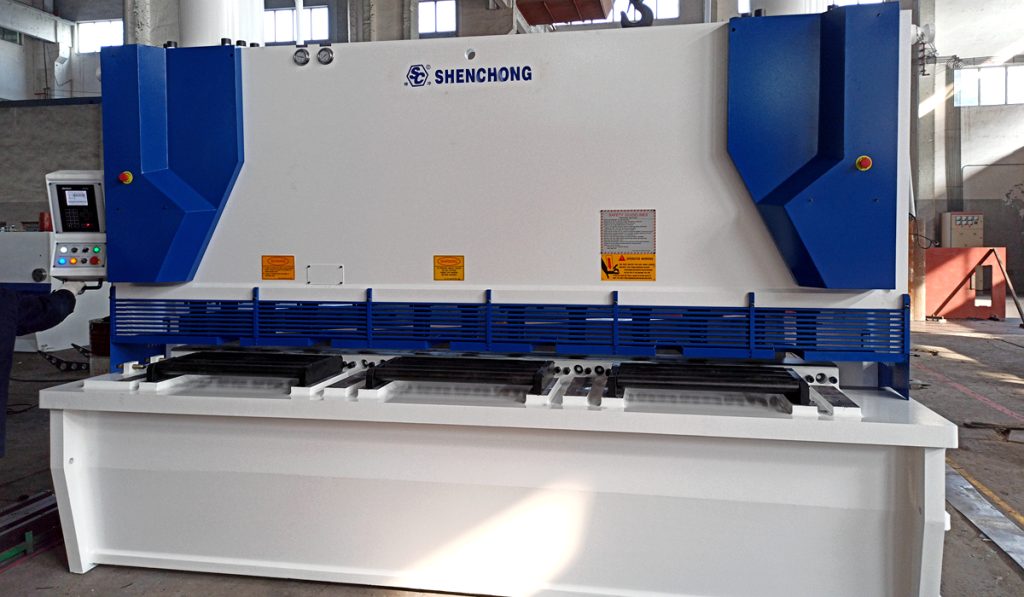
SC 30mm metal shearing machine is a heavy-duty shearing device designed for processing thick plates, heavy sheet metal, and high-strength metal materials. It typically employs a hydraulic guillotine shearing structure, using the shearing gap created between the upper blade holder and the lower blade to perform continuous and stable linear shearing of the steel plate.
Taking common models like 30×2500mm, 30×3200mm, and 30×4000mm as examples, “30” represents the maximum rated shearing thickness of approximately 30mm, and “2500/3200/4000” represents the maximum shearing length.
Most 30mm hydraulic guillotine shearing machines on the market are designed for rated capacity based on ordinary carbon steel with a tensile strength of approximately 450MPa. If the material strength is significantly higher, such as high-strength steel or stainless steel, the actual shearable thickness needs to be reduced accordingly.
1. 30MM Metal Plate Shearing Machine Overview
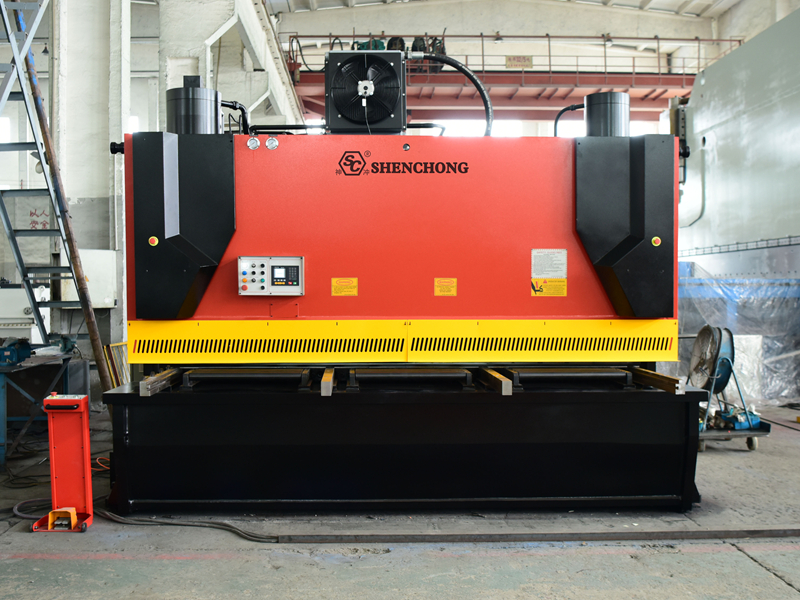
30mm metal plate shearing machine is essentially a heavy-duty hydraulic sheet metal shearing device, primarily used for straight-line cutting of large-size steel plates to specified lengths, widths, or profiles.
Common models include:
30×2500mm
30×3200mm
30×4000mm
30×5000mm
30×6000mm
Longer specifications can also be customized according to project requirements.
Where:
30mm = Rated maximum shearing thickness
3200mm = Maximum shearing length per pass
For example: 30×3200mm
This means that theoretically, the equipment can perform a straight-line shear of approximately 3200mm in width for 30mm thick plates within a specified material strength range.
However, actual parameters vary significantly between different manufacturers.
For example, in publicly available specifications, the shearing speed of the 30×2500mm model is approximately 4–8 cuts/min, and the 30×3200mm model is approximately 3–5 cuts/min, with the main motor power commonly ranging from 37–45kW. Higher configurations are also available.
Therefore, when purchasing, one should not only look at the number “30mm,” but should also consider: material strength + shearing thickness + shearing length + shearing speed + blade clearance + shearing angle + back gauge accuracy.
2. 30mm Hydraulic Guillotine Shearing Machine Basic Working Principle
Its basic working process can be understood as follows:
Feeding → Positioning → Pressing → Upper blade holder descends → Plate undergoes plastic deformation → Shearing and fracture → Upper blade holder returns → Removal
1) Plate Positioning
First, the steel plate is placed on the worktable.
The shearing dimensions of the plate are determined by:
- Front gauge
- Side positioning
- Rear gauge
- Scale
- CNC rear gauge
2) Pressing
The hydraulic system drives the pressing device to press the steel plate firmly.
For 30mm thick heavy steel plates, the pressing mechanism is especially important.
If the plate is not reliably pressed, the following may occur during the shearing process:
- Plate movement
- Non-perpendicular cut
- Dimensional errors
- Plate twisting
- Increased burrs on the cut
3) Upper Blade Holder Descends
Hydraulic oil enters the main cylinder, causing the upper blade holder to move downwards.
The upper blade and the fixed lower blade form a shearing action.
The blade does not cut the entire 30mm steel plate at once. Instead, it uses a shearing angle to gradually advance the shearing zone.
This reduces the instantaneous shearing load.
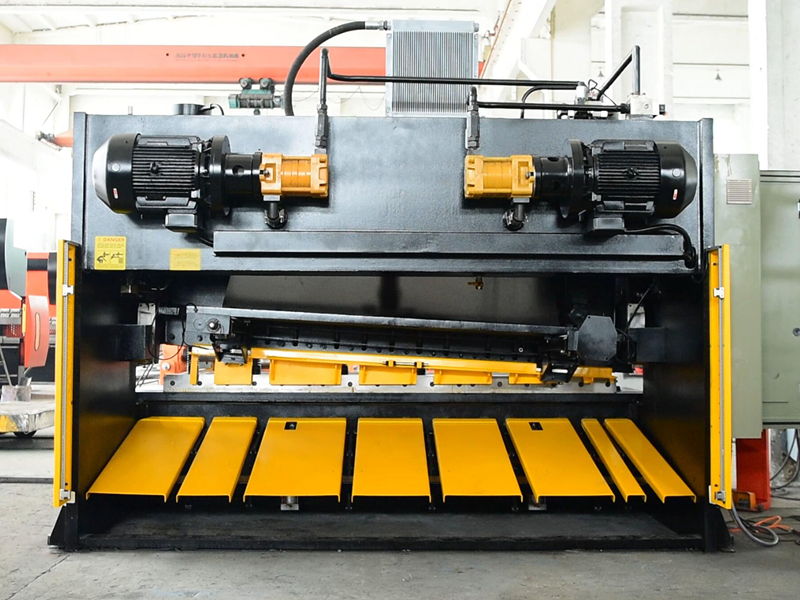
4) Plate is Sheared
The blade first presses into the steel plate.
As the blade continues to move:
Indentation → Plastic Deformation → Crack Initiation → Crack Propagation → Plate Separation
Ultimately forming a cut.
5) Upper Blade Post Return
After shearing, the upper blade post returns quickly or in a controlled manner, preparing for the next shearing operation.
3. 30mm Shearing Machine Reference Technical Parameters
The following are reference ranges for commonly used 30mm hydraulic guillotine shearing machines on the market; they are not fixed parameters for any particular brand.
Parameter Table:
Item | 30×2500 | 30×3200 | 30×4000 |
Maximum shearing thickness | 30mm | 30mm | 30mm |
Maximum shearing length | 2500mm | 3200mm | 4000mm |
Material tensile strength | ≤450MPa | ≤450MPa | ≤450MPa |
Shearing angle | 1°-3.5° | 1°-3.5° | 1°-3.5° |
Back gauge range | 20-1000mm | 20-1000mm | 20-1000mm |
Number of shearing cycles | 4-8times/min | 3-5times/min | 3-5 times/min |
Main motor | 37~55kW | 37~45kW+ | 45~55kW+ |
Blade | Multi-blade reversible | Multi-blade reversible | Multi-blade reversible |
Control method | NC/CNC | NC/CNC | NC/CNC |
Different manufacturers offer significantly different configurations for 30×2500, 30×3200, and 30×4000 systems. For example, publicly available data suggests a 45kW configuration for the 30×2500, while other manufacturers offer 37-40kW options for their 30×2500/3200 systems.
Therefore, the final technical agreement from the shearing machine manufacturer should be the standard for formal procurement.
4. What materials can a 30mm shearing machine cut?
This is a common point of misunderstanding during procurement.
A “30mm metal plate shearing machine” does not mean it can cut all 30mm thick metal materials.
The rated capacity of the equipment is usually related to the tensile strength of the material.
For example, ordinary low-carbon steel:
- Q235 / Ordinary carbon steel
Within the rated material strength range of the equipment, 30mm is a major processing capacity.
- High-strength steel
If the tensile strength of the material is significantly higher than the equipment’s design benchmark, the actual maximum shearing thickness must be reduced.
Some manufacturers publish data for 30×2500/3200 models, specifying a 30mm capacity for materials with a strength of approximately 450MPa and a 20mm capacity for materials with a strength of approximately 700MPa.
- Stainless steel
The shearing resistance of stainless steel such as 304 is generally higher than that of ordinary low-carbon steel.
Therefore: A 30mm shearing machine ≠ It can definitely cut 30mm thick 304 stainless steel.
If the customer primarily processes:
- 304
- 316L
- High-nickel stainless steel
- High-strength steel
The following should be provided before purchasing:
Material grade + Maximum thickness + Maximum width + Tensile strength
The manufacturer can then recalculate.
5. 30mm shearing machine blades
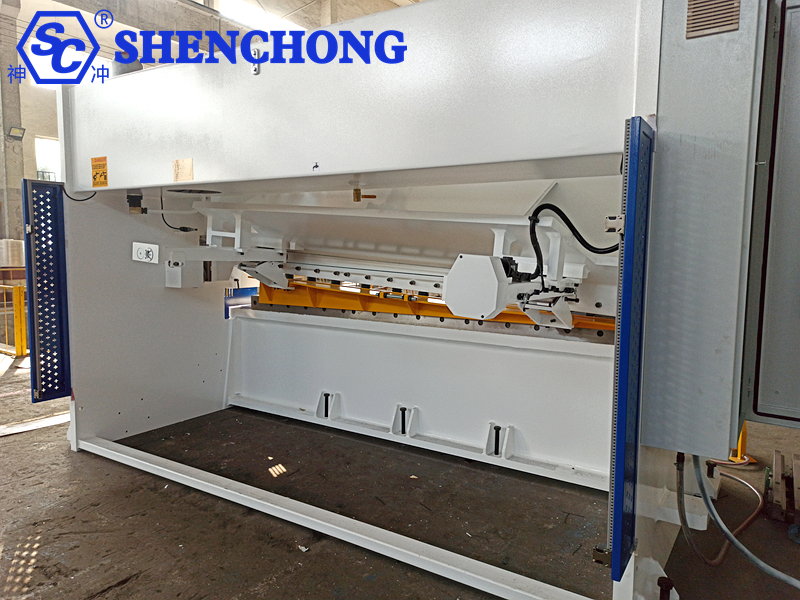
Thick plate shearing places high demands on the blades.
Common blade materials include:
- 6CrW2Si
- Cr12MoV
- H13K
Some 30×2500 models are publicly configured with Cr12MoV blades. They feature a four-flute design, allowing for flipping and reuse after the blade wears down.
Advantages of four-flute blades:
After one side wears down, it can be flipped → reused
This reduces long-term tool costs.
6. Automation Configuration of the 30mm Shearing Machine
For large-scale thick plate processing enterprises, the following can be added:
1) Front Feeding System
Suitable for:
- Large-size plates
- Heavy-duty plates
- Mass production
- Reduces manual handling.
2) Automatic Backgauge
Automatically completes dimensional positioning.
3) Plate Support Device
Used to support long, wide, and heavy plates.
4) Pneumatic Support/Pneumatic Material Handling
Reduces friction of plates on the worktable.
5) Conveying Device
Automatically conveys plates to designated areas after shearing.
6) Automatic Stacking
Further forming:
Loading → Positioning → Shearing → Conveying → Stacking
Automated production line.
7. Core Advantages of the 30mm Shearing Machine
The 30mm metal plate shearing machine is a high-rigidity, high-shearing-force hydraulic shearing solution for medium and heavy plates in the steel structure, engineering machinery, shipbuilding, pressure vessel, and heavy equipment manufacturing industries.
Advantage 1: Strong Thick Plate Processing Capability
The 30mm-class equipment primarily solves:
Thick plate processing tasks that ordinary medium-thick plate shearing equipment cannot complete.
Advantage 2: High Shearing Force
The heavy-duty hydraulic system provides significant shearing power.
Suitable for:
Steel structures, construction machinery, pressure vessels, boilers, shipbuilding, heavy machinery, metallurgical equipment, and other industries.
Advantage 3: Stable Cut Quality
Optimal settings:
Shearing angle, blade gap, clamping pressure, back gauge position
Result in excellent cut quality.
Advantage 4: Suitable for Batch Processing
With NC/CNC back gauge configuration, the same dimensions can be quickly and repeatedly sheared.
Advantage 5: High Blade Utilization
When using four-blade blades, blade life can be extended by flipping the blades.
Advantage 6: Long Equipment Lifespan
The heavy-duty frame, hydraulic system, and thick plate shearing structure make the equipment suitable for long-term industrial production.
 English
  Spanish
  Portuguese
  Russian
  Arabic
  French
  Italian
  German
  Polish
  Thai
Thai  Vietnamese
  Lithuanian
  Czech
Czech  Korean
  Japanese
  Chinese