
Table of Contents
1. Overview of Laser Cutting Parameter Table
In the laser cutting of metal sheets, process parameters directly determine cutting quality, cutting efficiency, equipment stability, and production costs.
For laser cutting process engineers, equipment debugging personnel, and on-site operators, establishing standardized parameter quick reference tables can significantly improve machine setup efficiency, reduce trial cutting time, and quickly achieve stable processing.
This laser cutting parameter quick reference table is primarily applicable to:
- Fiber laser cutting machines
- Low- and medium-power laser equipment
- High-power laser equipment
- Automated laser cutting production lines
- Sheet metal processing plants
- Steel structure processing industry
- Kitchenware industry
- Elevator industry
- Construction machinery industry
- Electrical cabinet industry
This data includes:
- Carbon steel cutting parameters
- Stainless steel cutting parameters
- Aluminum plate cutting parameters
- Brass cutting parameters
- Copper cutting parameters
- Zipper plate parameters
- Parameters for different thicknesses
- Parameters for different gases
- Focus parameters
- Perforation parameters
- Nozzle parameters
- High-frequency and low-frequency parameters
- Flying cut parameters
- Micro-connection parameters
- Thick plate parameters
- High-speed cutting parameters
- High-power parameters
- Common defect correction parameters
However, laser cutting machines from different manufacturers, models, and configurations vary. The following laser cutting parameter table is for user reference only.
2. Explanation of Core Parameters for Laser Cutting
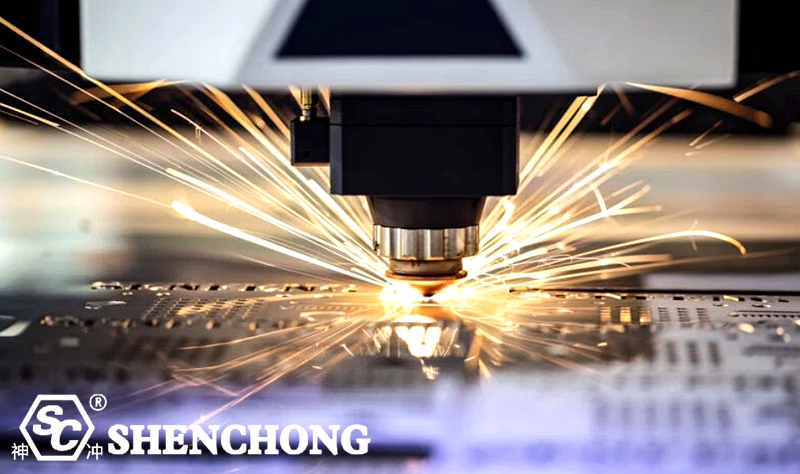
Laser Cutting Core Parameter Table:
Parameter Name | Parameter Functions | Adjustment Direction |
Laser Power | Determines cutting capacity | Higher power means stronger cutting ability for thicker plates |
Cutting Speed | Determines processing efficiency | Too fast, incomplete cut; too slow, edge burns |
Focus Position | Determines kerf quality | Positive focus is suitable for thin plates; negative focus is suitable for thick plates |
Gas Pressure | Determines slag removal capacity | Thick plates require higher air pressure |
Nozzle Diameter | Determines airflow pattern | Thick plates use larger nozzles |
Frequency | Determines pulse density | High frequency is suitable for thin plates |
Duty Cycle | Determines heat input | Affects edge quality |
Piercing Time | Determines drilling stability | Thick plates require longer drilling times |
Kirch Compensation | Determines dimensional accuracy | Especially important for precision parts |
3. Quick Reference Table for Carbon Steel Cutting Parameters
1000W Fiber Laser Carbon Steel Cutting Parameter Table:
Thickness | Gases | Pressure | Speed | Focus |
1mm | Oxygen | 0.5bar | 18-25m/min | +1 |
2mm | Oxygen | 0.6bar | 10-15m/min | +0.5 |
3mm | Oxygen | 0.7bar | 6-8m/min | 0 |
4mm | Oxygen | 0.8bar | 3-5m/min | -0.5 |
5mm | Oxygen | 0.9bar | 2-3m/min | -1 |
6mm | Oxygen | 1.0bar | 1-2m/min | -1.5 |
3000W Fiber Laser Carbon Steel Cutting Parameter Table:
Thickness | Gases | Pressure | Speed | Focus |
1mm | Nitrogen | 12bar | 35m/min | +1 |
2mm | Nitrogen | 14bar | 25m/min | +0.5 |
4mm | Oxygen | 0.8bar | 8-10m/min | -0.5 |
6mm | Oxygen | 0.9bar | 4-5m/min | -1 |
8mm | Oxygen | 1.0bar | 2-3m/min | -1.5 |
10mm | Oxygen | 1.1bar | 1.5-2m/min | -2 |
12mm | Oxygen | 1.2bar | 1-1.5m/min | -2.5 |
4. Quick Reference Table for Stainless Steel Laser Cutting Parameters
304 Stainless Steel Laser Cutting Parameter Table:
Thickness | Power | Gases | Pressure | Speed | Focus |
1mm | 1500W | Nitrogen | 14bar | 25m/min | +1 |
2mm | 1500W | Nitrogen | 15bar | 15m/min | +0.5 |
3mm | 2000W | Nitrogen | 16bar | 8-10m/min | 0 |
4mm | 3000W | Nitrogen | 18bar | 5-6m/min | -0.5 |
6mm | 6000W | Nitrogen | 20bar | 2-3m/min | -1 |
8mm | 12000W | Nitrogen | 22bar | 1.5-2m/min | -1.5 |
Stainless steel cutting techniques:
- High-purity nitrogen must be ensured.
- Nozzles must be concentric.
- Protective lenses must be clean.
- Stable airflow is extremely important.
- Overheating must be avoided during high-speed cutting.
5. Quick Reference Table for Aluminum Plate Cutting Parameters
Aluminum Plate Laser Cutting Parameter Table:
Thickness | Power | Gases | Pressure | Speed | Focus |
1mm | 2000W | Nitrogen | 18bar | 12m/min | +0.5 |
2mm | 3000W | Nitrogen | 20bar | 5m/min | 0 |
4mm | 6000W | Nitrogen | 22bar | 2m/min | -1 |
6mm | 12000W | Nitrogen | 24bar | 1m/min | -1.5 |
8mm | 20000W | Nitrogen | 18bar | 12m/min | +0.5 |
Precautions for cutting aluminum plates:
- High reflectivity of aluminum plates
- Reflective backlighting must be prevented from damaging the laser
- It is recommended to use a high-reflectivity cutting head
- Frequent inspections are necessary to protect the lens
- Drilling must be done slowly and steadily
6. Laser Cutting Parameters for Brass and Copper
Brass Laser Cutting Table:
Thickness | Power | Gases | Speed |
1mm | 3000W | Nitrogen | 15m/min |
2mm | 6000W | Nitrogen | 6m/min |
4mm | 12000W | Nitrogen | 2m/min |
Copper Laser Cutting Table:
Thickness | Power | Gases | Speed |
1mm | 3000W | Nitrogen | 10m/min |
2mm | 6000W | Nitrogen | 4m/min |
4mm | 12000W | Nitrogen | 1m/min |
7. Quick Reference Table for Laser Cutting Nozzle Selection
Thickness | Recommended nozzle |
1-3mm | Single layer 1.0 |
4-6mm | Single layer 1.2 |
8-12mm | Single layer 1.5 |
14-20mm | Double layer 2.0 |
over20mm | Double layer 2.5 |
8. Focus Adjustment Quick Reference Table
Materials | Thin plate focus | Thick plate focus |
Carbon steel | Positive focus | negative focus |
Stainless steel | Micro positive focus | slightly negative focus |
Aluminum plate | Positive focus | slightly negative focus |
Copper plate | Positive focus | negative focus |
Focal focus rules:
- Lower focal length results in stronger cutting capability for thicker plates
- Higher focal length results in faster cutting speed for thinner plates
- Negative focal length is more conducive to slag removal
- Positive focal length is more conducive to high-speed cutting
9. Quick Reference Table for Laser Perforation Parameters
Plate thickness | Drilling methods | Time |
1-3mm | High-frequency instantaneous drilling | 0.1-0.3s |
4-8mm | Ordinary drilling | 0.5-1s |
10-20mm | Progressive drilling | 2-5s |
Over 20mm | Graded drilling | 5-15s |
10. Common Defects and Parameter Corrections
1) Severe Burrs
Causes:
Excessive speed
Insufficient power
Focus deviation
Insufficient air pressure
Solutions:
- Reduce speed
- Increase power
- Adjust focus
- Increase air pressure
2) Severe Edge Burning
Causes:
- Excessive speed
- Heat buildup
- Excessive power
Solutions:
- Increase speed
- Reduce power
- Use flying cut
3) Severe Slag Retention
Causes:
- Insufficient air pressure
- Nozzle blockage
- Focus too high
Solutions:
- Increase air pressure
- Replace nozzle
- Lower focus
11. High-Power Laser Cutting Parameter Strategies
With the widespread adoption of 12000W, 20000W, and 30000W ultra-high power equipment, cutting processes have undergone significant changes.
High-Power Features:
- Strong Thick Plate Capability
- Significant High-Speed Cutting Advantages
- More Concentrated Heat
- Narrower Process Window
- Higher Airflow Requirements
High-Power Process Core:
- Stable Airflow
- Precise Focus
- High-Speed Dynamic Response
- Automatic Focusing System
- Intelligent Drilling Control
12. Laser Cutting Parameter Optimization Logic
Excellent process engineers must establish a complete parameter optimization logic.
Core Adjustment Sequence:
- Power
- Focus
- Air Pressure
- Nozzle
- Speed
- Frequency
- Duty Cycle
- Lead Wire
- Drilling
Adjustment Principles:
- Adjust only one parameter at a time
- Keep variables unique
- Establish a standard database
- Record optimal parameters
- Establish material archives
13. Future Trends of Intelligent Process Database
The future of laser cutting technology will gradually enter the era of AI intelligence.
Future directions include:
- AI-powered automatic parameter tuning
- Automatic material identification
- Automatic path optimization
- Intelligent perforation control
- Real-time quality monitoring
- Automatic process correction
- Cloud-based process database
- Self-learning system
Future laser cutting will no longer rely on “experienced master craftsmen,” but rather on data-driven, intelligent, and automated process systems.
14. Summary
Laser cutting parameters are the core technological foundation of the entire laser processing industry. The laser cutting parameter table above, provided for user convenience, is for reference only. Different manufacturers, models, and configurations of laser cutting machines will have variations. Users should determine and use parameters based on their specific circumstances.
Truly excellent cutting results do not solely rely on high-end equipment, but rather on:
- Correct parameters
- Stable process
- Complete database
- Rich experience in machine tuning
- Precise equipment maintenance
- Automated process capabilities
In the future, whoever masters the process database will hold the core competitiveness of the laser cutting industry.

 English
  Spanish
  Portuguese
  Russian
  Arabic
  French
  Italian
  German
  Polish
  Thai
Thai  Vietnamese
  Lithuanian
  Czech
Czech  Korean
  Japanese
  Chinese