
Table of Contents
The sheet rolling process, seemingly a simple process of shaping a flat plate into a cylinder or arc, actually involves multiple stages, including material properties, plate thickness and width, rolling machine structure, roller geometry, pre-bending, feeding positioning, reduction amount, rolling sequence, springback control, and pre- and post-welding corrections.
If the goal is not merely “rolling into a circle,” but rather achieving good roundness, stable diameter, short straight sections at the ends, accurate seam alignment, high batch consistency, and high production efficiency, then the entire process needs to be upgraded from “single-machine operation” to a complete process control flow.
1. How to optimize the metal sheet rolling process?
1) First, clarify the core objective of "perfecting the rolling process"
A high-quality sheet metal rolling process typically requires simultaneous control of the following indicators:
Control Objectives | Key Features |
Roundness | Finished cross-section closely approximates the design circle |
Diameter Accuracy | Actual diameter matches drawing dimensions |
Ovalness | Reduces differences between major and minor axes |
End Quality | Reduces straight edges, collapsed edges, and flattened ends |
Joint Quality | Achieves accurate alignment at both ends |
Base Material Surface | Reduces scratches, indentations, and roller marks |
Batch Consistency | Maintains dimensional stability across multiple products |
Production Efficiency | Reduces repeated adjustments and rework |
Safety | Prevents sheet material slippage, swaying, and pinching. |
Therefore, improving the sheet rolling process should not only focus on whether the rolling machine pressure is sufficient, but should optimize six aspects:
material → equipment → process → operation → inspection → correction.
2) Before Rolling: Prepare the Material Properly
Many rolling quality problems actually arise before the sheet metal enters the rolling machine.
- Check the Sheet Thickness
A difference between the actual thickness and the theoretical thickness will directly affect the bending radius.
For example, if the design uses: 10 mm steel plate
The actual thickness may have a certain tolerance.
In high-precision cylinder manufacturing, the actual plate thickness should be checked as much as possible, rather than setting parameters strictly according to the nominal thickness.
- Check the Material Grade
Different materials have different yield strengths, tensile strengths, and elongations.
Common materials include:
- Q235
- Q355
- 304 stainless steel
- 316L stainless steel
- Aluminum plate
- Copper plate
- Nickel-based alloys
- High-strength steel
Even with the same 10 mm sheet metal, different materials may require significantly different rolling pressures and springback compensations.
For example:
304 stainless steel typically exhibits a more pronounced springback characteristic than ordinary carbon steel.
Therefore, the rolling parameters for ordinary carbon steel cannot be simply applied.
3) Sheet Pretreatment
Sheet pretreatment is crucial.
- Check the Material Grade
If the sheet itself has:
- central bulges
- edge warping
- local waviness
- twisting
After entering the rolling mill, it is prone to:
unstable roundness + edge deformation + localized radius abnormalities.
Leveling should be performed if necessary.
- Clean the sheet surface
Before rolling, remove:
- iron filings
- weld slag
- oil
- scale
- foreign matter
Especially stainless steel and aluminum sheets.
If hard foreign matter is present on the roll surface, it can easily form permanent indentations.
For high surface quality products, consider:
protective film + cleaning the roll surface + special roll surface treatment.
4) Determine the Correct Sheet Rolling Process Route
Different rolling machines have different process routes.
Common equipment includes:
- Three-roll rolling machine
Includes:
- Symmetrical three-roll
- Asymmetrical three-roll
- Upper-roll universal three-roll
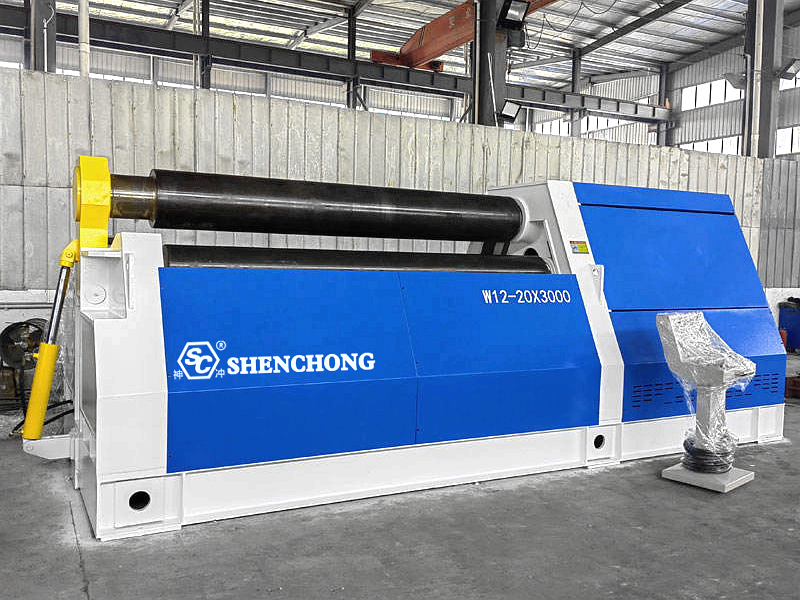
- Four-roll rolling machine
Typically has:
- Upper roll
- Lower roll
- Left roll
- Right roll
For production requiring high efficiency, high precision, and fewer straight edges at the ends, the four-roll rolling machine has significant process advantages.
5) The most critical step in rolling: Pre-bending
If pre-bending is ignored, many products, even if finally rolled into a circle, are prone to having excessively long straight edges at both ends.
For example: The ends of the sheet metal may retain long straight areas.
This condition is detrimental to subsequent processes:
- Butt welding
- Cylinder splicing
- Flange installation
- Roundness control
Why is end pre-bending necessary?
During the sheet rolling process, the sheet metal can only form a stable bend after entering the effective envelope area of the rollers.
Therefore, the initial end area of the sheet material entering the equipment often suffers from insufficient effective bending length.
The purpose of pre-bending is to pre-form the target curvature at the sheet material end.
The final process is: Pre-bending → Rolling → Jointing → Rounding
Instead of simply rolling directly.
6) Accurately Determine the Target Rolling Diameter
Rolling is not simply rolling the sheet material to the “drawing diameter.”
It needs to consider:
- Sheet thickness
- Material
- Neutral layer position
- Springback
- Rolling method
- Roller diameter
- Final product inspection location
For example: Outer diameter Ø1000 mm
If 1000 mm is directly used as the target for roller spacing control, the actual finished product may deviate from the target size due to material springback.
Therefore, the actual process needs to establish a closed loop:
Target size → Theoretical reduction → Springback compensation → Actual inspection → Parameter correction
7) Control the "reduction" during rolling
This is one of the core parameters determining the quality of rolling.
Insufficient pressure:
Insufficient bending of the sheet material; excessive diameter after springback; requires multiple re-rolling cycles.
Excessive pressure:
Easily causes excessive plastic deformation; increases equipment load; may cause localized deformation; degrades surface quality.
Therefore, it is recommended to use: gradual pressure + multi-pass rolling, rather than pressing the sheet material to the final position all at once.
8) Multi-pass rolling more stable than single-pass forming
A typical process can be designed as follows:
Pass 1:
Sheet material enters → initial bending.
Pass 2:
Increase pressure → expand the bending area.
Pass 3:
Continue rolling → approaching the target diameter.
Pass 4:
Finishing → eliminate localized errors.
Pass 5:
Joining → check roundness.
This method is particularly suitable for:
- Thick plates
- High-strength steel
- Stainless steel
- Large-diameter cylinders
- High-precision cylinders
9) Controlling the feeding angle using side rollers
For four-roll plate rolling machines, the plate’s posture can be adjusted using side rollers.
If the plate’s entry angle is incorrect, the following may occur:
- Misaligned ends
- Conical cylinder
- Uneven roundness
- Difficulty in aligning seams
Therefore, before formal rolling, the following should be performed:
Positioning → Centering → Clamping → Trial rolling.
10) Rounding after rolling cannot be omitted
Even if the rolling process is well controlled, the finished product may still exhibit:
- Oval
- Local bulges
- Deformation in the seam area
- Unrounded ends
Therefore, rounding is usually required:
Using appropriate roller pressure to refine the cylinder.
The purpose is not to re-roll, but to: eliminate local errors and make the overall cylinder roundness more consistent.
2. How to Improve Quality Of Sheet Metal Rolling?
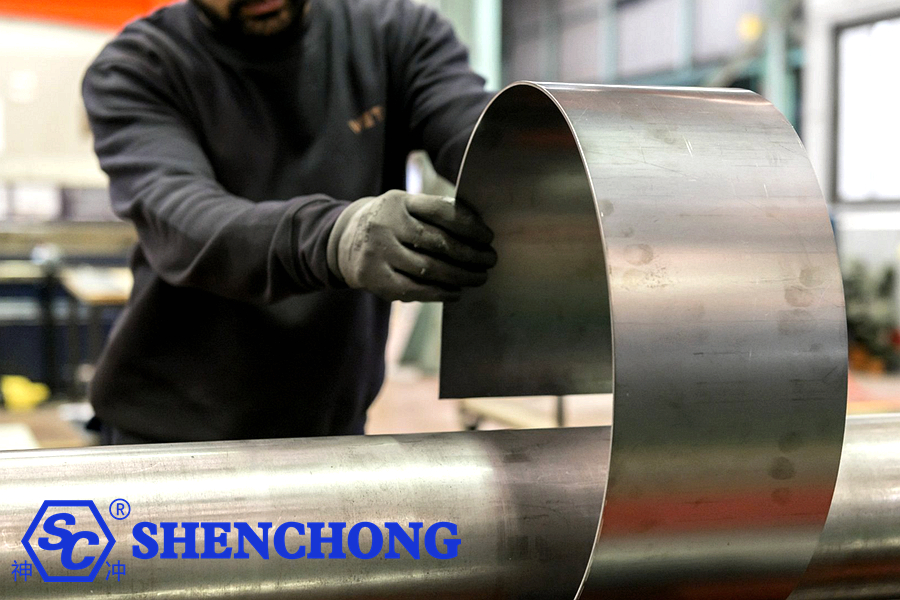
Improving the quality of sheet rolling is not simply about increasing the pressure of the rolling machine, but rather about simultaneously optimizing material preparation, equipment selection, pre-bending process, rolling parameters, springback compensation, sheet metal positioning, process inspection, and rounding calibration.
The goals can be summarized as:
Rolling more evenly, with more accurate dimensions, shorter straight edges, better surface finish, more stable batches, and higher efficiency.
Step 1: Improve Sheet Metal Pre-treatment Quality
Many rolling problems are not caused by the rolling machine itself, but rather by issues present before the sheet metal enters the equipment.
1) Check the Actual Sheet Thickness
Parameters should not be set solely based on the nominal thickness.
For example: 12 mm steel sheet
The actual thickness may have manufacturing tolerances, and the rolling radius is highly sensitive to variations in sheet thickness.
For high-precision products, the actual sheet thickness should be measured and used as one of the process parameters.
2) Check the flatness of the sheet material
Focus on checking:
- Center bulges
- Edge warping
- Wavy deformation
- Twisting
- Local depressions
If the sheet material itself is uneven, it will be difficult to achieve a stable roundness after rolling.
3) Clean the sheet material and roller surface
Especially for products with high surface requirements such as stainless steel and aluminum plates, avoid:
- Iron filings
- Weld slag
- Oxide scale
- Metal particles
- Oil stains
Entering between the roller and the sheet material.
Step 2: Selecting the Right Plate Rolling Machine
The equipment structure directly affects the sheet rolling process.
Common equipment includes:
- Three-roll plate rolling machine
- Symmetrical three-roll plate rolling machine
- Asymmetrical three-roll plate rolling machine
- Upper roller universal plate rolling machine
- Four-roll plate rolling machine
For products requiring high roundness, short straight edges, and high production efficiency, four-roll plate rolling machines are generally easier to achieve stable positioning, pre-bending, and rolling.
Step 3: Emphasize End Pre-bending
This is one of the most important steps in improving rolling quality.
If pre-bending is insufficient, the final product is prone to having excessively long straight edges at both ends.
Therefore, the complete process should be: end pre-bending → main body rolling → jointing → finishing. Rather than simply rolling the flat plate directly into a circle.
Step 4: Optimize the reduction amount
Reduction amount is the core parameter determining the quality of the roll.
Insufficient reduction
May lead to:
- Diameter being too large
- Radius increasing after springback
- Insufficient roundness
- Requiring repeated rolling
Excessive reduction
May lead to:
- Localized excessive deformation
- Surface indentations
- Increased equipment load
- Insufficient size
Therefore, a more reasonable method is: small-step reduction, multi-pass forming.
This is especially important for thick plates, high-strength steel, and stainless steel.
Step 5: Change from "one-time rolling" to "multi-pass rolling"
For example, for a thick plate cylinder, the following can be used:
First pass: initial bending
↓
Second pass: expanding the bending area
↓
Third pass: approaching the target diameter
↓
Fourth pass: jointing
↓
Fifth pass: finishing and rounding
This method is generally easier to control in terms of size and roundness than a single large reduction.
Step 6: Strengthen Sheet Alignment
If the sheet metal is skewed when entering the rolling machine, it is prone to the following problems:
- Conical shape
- Different diameters at both ends
- Misaligned joints
- Inconsistent roundness
Therefore, during feeding, it is essential to control:
Sheet metal centerline = Rolling machine centerline
This can be achieved using:
- Positioning lines
- Side positioning devices
- Laser positioning
- CNC positioning
- Mechanical stops
- Improving feeding repeatability
Step 7: Focus on Controlling Material Springback
Metal sheets undergo elastic recovery after unloading.
Therefore: The shape on the machine is not necessarily the final shape after unloading.
Special attention should be paid to:
- High-strength steel such as Q355
- 304 stainless steel
- 316L stainless steel
- High-strength alloy steel
For materials with significant springback, specific springback compensation parameters should be established.
For example:
Target diameter → Theoretical rolling diameter → Springback compensation → Actual inspection → Parameter correction
Gradually develop the company’s own process database.
Step 8: Establish a parameter database for "material + thickness + diameter"
This is a very effective method to improve consistency in mass production.
For example:
Material | Thickness | Patent Width | Target Diameter | Pre-bending Parameters | Rolling Parameters |
Q235 | 6 mm | 2000 mm | Ø500 | A | A |
Q235 | 10 mm | 3000 mm | Ø800 | B | B |
Q355 | 12 mm | 3000 mm | Ø1000 | C | C |
304 | 8 mm | 2000 mm | Ø600 | D | D |
304 | 12 mm | 3000 mm | Ø1200 | E | E |
Operators will no longer need to rely entirely on experience and can directly access verified parameters.
Improving the synchronization accuracy of the hydraulic system and rollers
This is especially important for large hydraulic plate rolling machines.
If there is a significant difference in the position of the left and right side rollers, it may cause the plate to tilt and taper.
Therefore, the following aspects need to be carefully controlled:
- Synchronization of left and right hydraulic cylinders
- Displacement feedback
- Hydraulic pressure
- Side roller position
- Closed-loop control of the CNC system
For high-precision rolling, position control accuracy is often more important than simply increasing hydraulic pressure.
Improving Production Efficiency: Reducing "Repeated Rolling"
Traditional metal sheet rolling production often involves:
Roll once → Measure → Adjust → Reroll → Remeasure
While this completes the process, it’s inefficient and heavily reliant on operator experience.
A better approach is:
Step 1
Record material and product information.
Step 2
Recall historical parameters.
Step 3
Automatically position the rollers.
Step 4
Automatically execute the pre-bending procedure.
Step 5
Automatically execute multiple rolling passes.
Step 6
Finishing.
Step 7
Inspect and save the actual results.
This gradually leads to a digitalized sheet metal rolling process.
3. How to Reduce Straight Edges?
Reducing straight edges is key to improving the sheet rolling process.
Main methods include:
Method 1: Sufficient Pre-bending
Increase the degree of pre-bending at the ends.
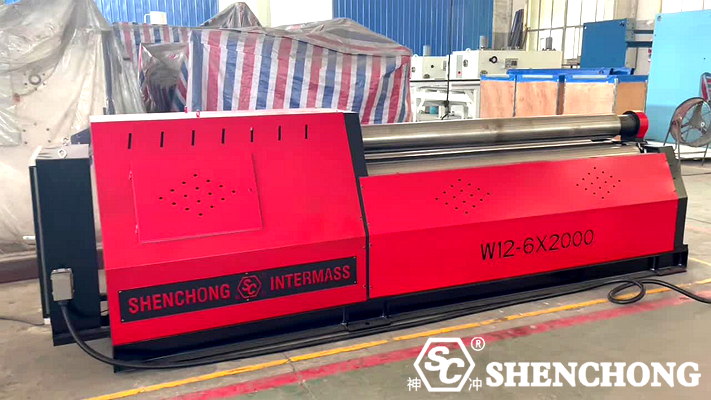
Method 2: Using a Four-Roll Plate Roller
Improve end forming capability through side roller control.
Method 3: Appropriately Increasing the Pre-bending Amount
Avoid insufficient pre-bending.
Method 4: Increasing Finishing Passes
For high-precision cylinders, multiple finishing passes can be performed.
Method 5: Using Appropriate Roller Diameter
Roller diameter that is too large or process parameters that are mismatched can affect end forming.
4. Springback Control
Material springback must be considered. After plastic deformation, metal sheets undergo a certain degree of elastic recovery.
Springback Control for Different Materials
Generally speaking:
Materials | Rebound control |
Ordinary low carbon steel | Relatively easy |
Q235 | Easier to control |
Q355 | Increase compensation |
304 stainless steel | Requires careful consideration |
316L stainless steel | Requires careful consideration |
High-strength steel | Rebound is more pronounced |
Aluminum alloy | Requires adjustment based on grade |
Therefore, the parameters of a plate rolling machine cannot be set solely based on “thickness.”
At least the following should be considered: Thickness + Material + Width + Target Diameter.
5. Summary
An ideal modern plate rolling process:
Sheet material storage
↓
Material identification
↓
Thickness/width detection
↓
Sheet material leveling
↓
CNC positioning
↓
Precise centering
↓
End pre-bending
↓
Multi-pass rolling
↓
Automatic jointing
↓
Preliminary inspection
↓
Finishing and rounding
↓
Welding
↓
Post-weld roundness inspection
↓
Final dimension inspection
↓
Process parameter archiving
The most effective improvement method can be summarized as “10 key actions.”
If the entire method were to be condensed into a version easily implemented on-site, it can be summarized as:
- Choose the right equipment
Select a plate rolling machine based on the material, thickness, width, and diameter.
- Inspect the material first
Confirm the grade, thickness, and flatness.
- Keep the roller surface clean
Avoid surface scratches.
- Precise centering
Avoid taper in the cylinder.
- Proper pre-bending
Reduce straight edges at the ends.
- Reasonable pressing
Avoid excessive pressing at once.
- Multi-pass rolling
Improve roundness and stability.
- Effective springback compensation
Pay special attention to stainless steel and high-strength steel.
- Final rounding
Eliminate local deformation.
- Establish a data loop
Save successful parameters and gradually develop standard processes.
 English
  Spanish
  Portuguese
  Russian
  Arabic
  French
  Italian
  German
  Polish
  Thai
Thai  Vietnamese
  Lithuanian
  Czech
Czech  Japanese
  Chinese