
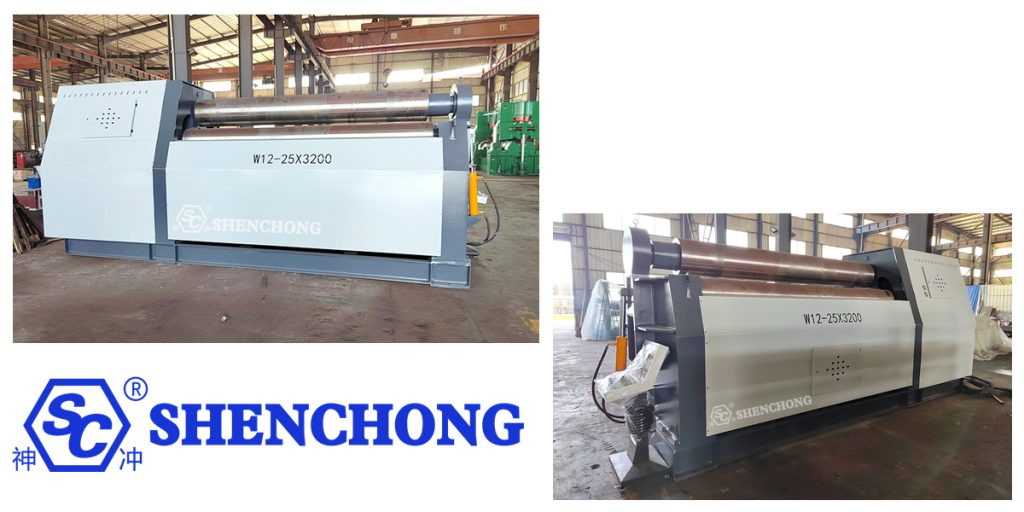
SC W12 25X3200 four-roll plate rolling machine is a high-rigidity hydraulic four-roll plate bending equipment designed for processing medium and heavy plates. It is mainly used to roll carbon steel, stainless steel, low alloy steel, and other metal plates into cylinders, arcs, cones, and other curved workpieces.
The core processing capabilities of this specification are typically: maximum plate thickness 25mm, maximum effective plate width 3200mm, and pre-bending thickness approximately 20mm. It is suitable for industries such as pressure vessels, storage tanks, boilers, steel structures, wind power, petrochemicals, construction machinery, pipelines, and large equipment manufacturing.
1. Basic Parameters of the W12 25X3200 Four-Roll Plate Rolling Machine
Below is a representative configuration parameter for the W12 25X3200 four-roll plate rolling machine:
Item | Reference Parameters |
Equipment Model | W12-25×3200 Four-Roll Hydraulic Plate Rolling Machine |
Structural Form | 25mm |
Maximum Coil Thickness | 20mm |
Maximum Pre-bending Thickness | 3200mm |
Maximum Coil Width | Approx. 3300mm |
Effective Length of Work Roller | ≤245MPa |
Sheet Yield Strength | Approx. 430mm |
Upper Roller Diameter | Approx. 390mm |
Lower Roller Diameter | Approx. 330mm |
Side Roller Diameter | Approx. 4.5m/min |
Coil Speed | Approx. 22kW |
Main Drive Power | Hydraulic Drive |
Drive Type | NC/CNC Optional |
Control Method | Double-End Pre-Bending |
Pre-bending Method | Configurable |
Conical Coiling | Optional |
Large Diameter Workpiece Support | Carbon Steel, Stainless Steel, Low Alloy Steel, etc. |
Material Type | W12-25X3200 Four-Roll Hydraulic Plate Rolling Machine |
The parameters mentioned above represent a typical configuration and are not identical for all W12-25×3200 products. For example, other manufacturers’ models of the same specifications may use a 30kW main motor and 430/390/340mm roll diameters.
Therefore, 25X3200MM does not represent a globally unified standard, especially regarding minimum rolling diameter, roll diameter, motor power, hydraulic system pressure, and number of control shafts, which need to be confirmed in conjunction with the manufacturer’s technical specifications.
2. What is a W12 four-roll plate rolling machine?
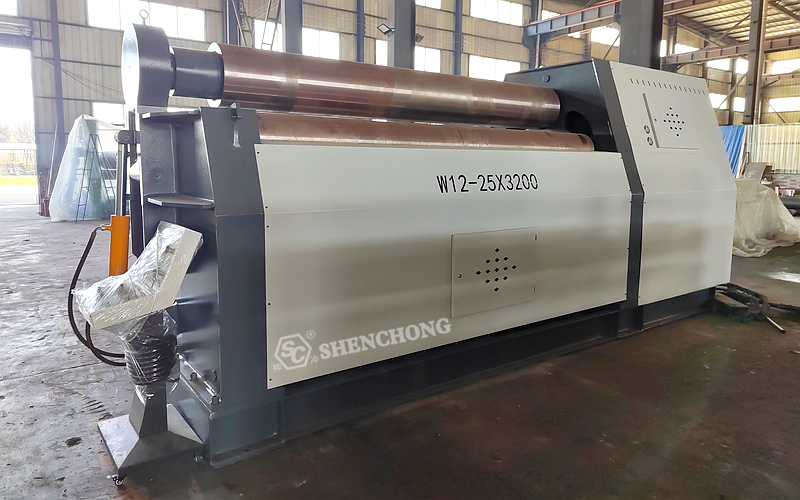
The W12 is a typical 4-roll metal sheet rolling machine.
Compared to a three-roll plate rolling machine, it adds a lower roll for clamping and positioning, allowing the sheet metal to form a more stable clamping state between the upper and lower rolls. Simultaneously, the bending radius of the sheet metal is controlled by the left and right side rolls.
The four working rolls perform different functions:
1) Upper Roll
The upper roll is usually the most important working roll of the equipment and one of the main drive rolls.
Main functions:
- Pressure the sheet metal
- Provide rolling pressure
- Work with the lower roller to form a clamping mechanism
- Drive the sheet metal longitudinally
- Participate in the final arc forming
For 25mm medium-thick plates, the rigidity and surface quality of the upper roller are crucial.
2) Lower Roller
The lower roller is mainly responsible for:
- Clamping the steel plate
- Providing stable frictional driving force
- Working with the upper roller to form a clamping area
- Assisting in sheet metal positioning
- Controlling the position of the sheet metal through the rolling area
One of the biggest features of a four-roll mill is its ability to reliably clamp the steel plate using both upper and lower rollers.
3) Left Roller
The left roller is mainly used for:
- Pre-bending the left end of the sheet metal
- Controlling the rolling radius
- Supporting the sheet metal
- Adjusting the bending trajectory of the sheet metal
4) Right Roller
The right roller works in conjunction with the left roller to complete the pre-bending of the other end and continuous rolling.
Therefore, a four-roll mill can achieve a typical process:
Clamping → Front pre-bending → Rolling → Rear pre-bending → Rounding
This is also an important reason why four-roll mills are suitable for continuous production of medium-thick plates.
3. Core Working Principle of W12 25X3200 Plate Rolling Machine
The basic principle of a 4-roll plate bending machine can be summarized as follows:
The upper and lower rollers clamp the steel plate, and the positional changes of the left and right side rollers create a bending moment. As the work rollers rotate, the plate gradually undergoes plastic deformation, ultimately forming the target cylinder, cone, or curved surface.
Simply put:
- The upper and lower rollers are responsible for “clamping”
- The side rollers are responsible for “bending”
- The drive system is responsible for “feeding”
- The control system is responsible for “positioning”
All four work together to complete the plate bending process.
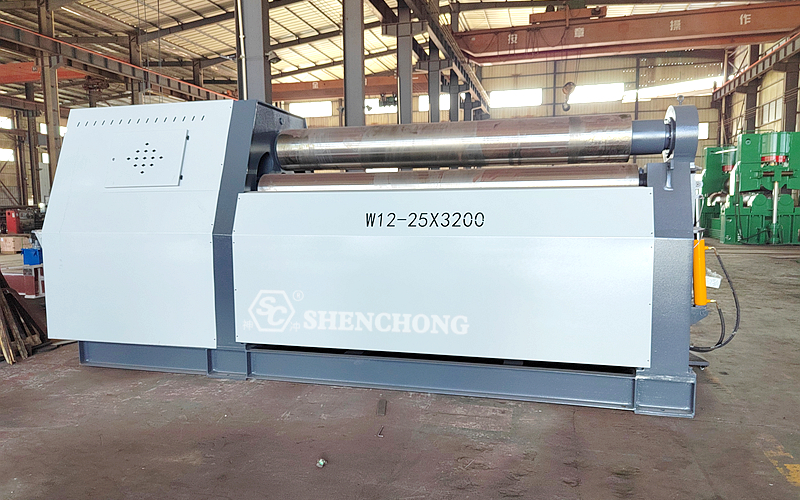
4. Typical Rolling Process For W12 Roll Bending Machine
Step 1: Steel Plate Loading
The steel plate, after shearing, laser cutting, or other processing, is placed at the feeding position of the rolling machine.
For large-size steel plates (25mm thick), the following configurations are recommended:
- Feeding platform
- Front-end support device
- Lifting equipment
- Plate positioning device
- Lateral centering device
Large steel plates are heavy, and manual handling is not only inefficient but also prone to collisions and safety risks.
Step 2: Plate Centering
After the steel plate enters between the upper and lower rollers, it needs to be laterally centered.
Centering accuracy directly affects:
- Parallelism of both ends of the cylinder
- Cylinder axis
- Cone angle
- Weld position
- Subsequent assembly accuracy
For 3200mm wide steel plates, it is recommended to establish a clear centering benchmark in the production process.
Step 3: Lower Roller Lifting and Clamping
The lower roller moves upward, pressing the steel plate between the upper and lower rollers.
At this point, it is necessary to ensure that: the clamping force is sufficient but not excessive.
Insufficient clamping may lead to:
- Sheet slippage
- Instantaneous rolling radius
- Surface scratches
- Sheet misalignment
Over-clamping may increase the load on the roller system and hydraulic system.
5. Core Technological Advantages
1) Complete all processes in one clamping
- Automatic pre-bending of both ends
- No need for repeated edge changes
- Forming efficiency increased by 30%+
Suitable for mass production
2) High-precision rolling capability
- Hydraulic synchronous control accuracy up to ±2mm
- Good roundness, short straight edges
Suitable for pressure vessel grade products
3) Strong heavy-duty structural design
- Frame: Q235 welded + integral machining
- Roller: 42CrMo forged + quenched
- Hardness: HRC45-55 (surface)
Strong resistance to deformation, suitable for thick plate processing
4) Automation and CNC capabilities
- CNC control (PLC/touch screen)
- Automatic positioning side rollers
- Parameter memory function
Supports consistent batch production
5) Expandable automation system
Optional configurations:
- Upper bracket (large diameter rolling)
- Side bracket (anti-collapse)
- Automatic feeding table
- Conical rolling device
Suitable for automated production line integration
W12 25X3200 Four-Roll Plate Rolling Machine
25mm medium-thick plate × 3200mm wide plate × Four-roll double-end pre-bending
For 25mm medium-thick steel plates, the four-roll structure reduces repeated clamping and manual adjustment, which is beneficial to improving production efficiency and batch processing consistency. The pre-bending and continuous rolling capabilities of the four-roll machine are also important features that distinguish it from traditional three-roll machines.
High-rigidity roller system · Powerful hydraulic drive · Precise CNC positioning · Double-end pre-bending · High-efficiency rolling · Stable rounding
Using a high-rigidity four-roll structure and hydraulic drive system, it can realize integrated processing of multiple processes such as sheet clamping, double-end pre-bending, continuous rolling, and rounding. It can efficiently form cylindrical, arc-shaped and conical workpieces for industries such as pressure vessels, storage tanks, steel structures, wind power, petrochemicals and large equipment manufacturing.
 English
  Spanish
  Portuguese
  Russian
  Arabic
  French
  Italian
  German
  Polish
  Thai
Thai  Vietnamese
  Lithuanian
  Czech
Czech  Japanese
  Chinese