
Table of Contents
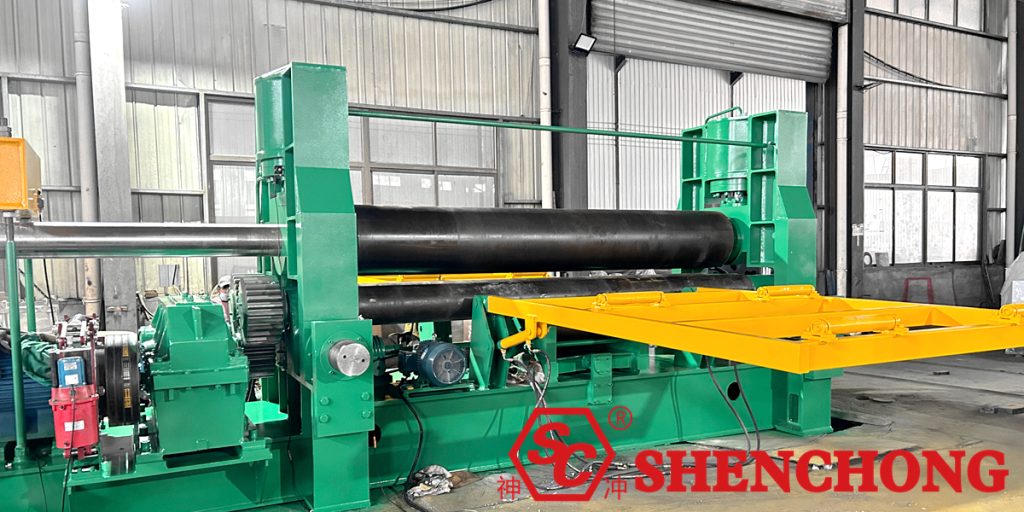
SC 40X3500mm universal plate rolling machine is a heavy-duty three-roll plate rolling machine designed for the manufacture of medium-thick and thick plates and large cylindrical bodies. Its core advantages lie in the universal adjustment of the upper roll, strong end pre-bending capacity, wide rolling range, and suitability for continuous production of large cylindrical bodies. It is an important forming equipment in the pressure vessel, storage tank, wind power, petrochemical, and heavy steel structure industries.
1. Overview of SC 40X3500mm Universal Plate Rolling Machine
The 40×3500mm upper-roller universal plate rolling machine is a type of 3-roll plate rolling equipment designed for the manufacture of medium-thick plates, high-strength steel plates, and large cylindrical bodies.
It typically adopts a universal upper roll structure such as W11S/W11SNC. Its core feature is that the upper roll can both lift and move horizontally, achieving pre-bending and rolling of the plate through changes in the upper roll position.
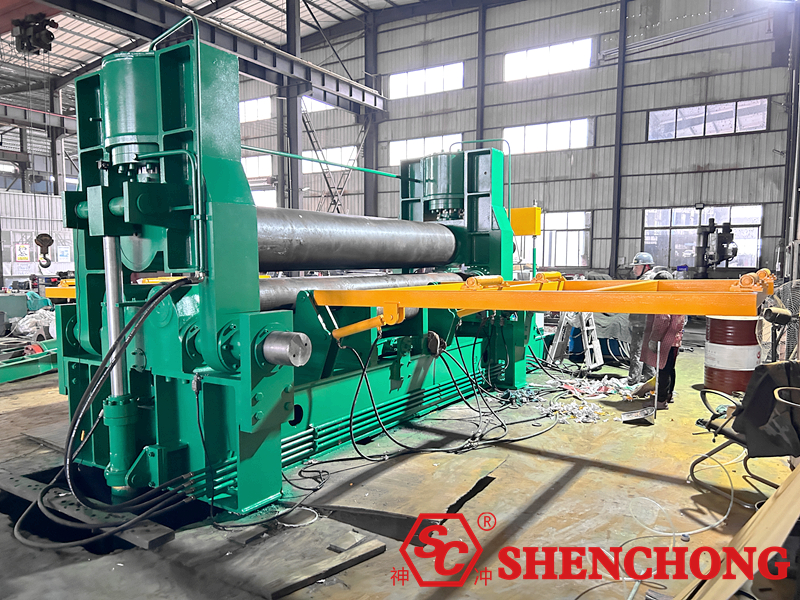
The universal plate rolling machine is a type of three-roll plate rolling machine. The biggest difference between this type of machine and a regular symmetrical three-roll plate rolling machine is that:
Regular symmetrical three-roll plate rolling machines mainly rely on the lifting and lowering of the upper roll to adjust the rolling radius, while the universal upper roll plate rolling machine, in addition to lifting and lowering the upper roll, can also achieve horizontal movement of the upper roll, giving the equipment a more flexible end pre-bending capability.
Therefore, it is particularly suitable for:
- Pressure vessel shells
- Storage tanks
- Oil tanks
- Wind towers
- Wind turbine towers
- Boiler shells
- Chemical equipment
- Pipelines
- Steel structures
- Engineering machinery structural components
- Large cylindrical and curved workpieces
Some universal upper roll machines can also be extended to process conical cylinders, variable diameter cylinders, and large thin-walled cylinders by adding accessories such as conical rolling devices, side supports, and upper supports.
2. Parameter Description
“40×3500mm” typically indicates the equipment’s typical specifications: maximum rolling thickness approximately 40mm, maximum effective rolling width approximately 3500mm.
The actual 40mm rolling capacity must be determined in conjunction with the sheet yield strength, roll diameter, upper roll diameter, and the manufacturer’s specified operating conditions. It cannot be simply assumed that any 40mm steel plate can be rolled.
Among existing equipment of the same specifications, some manufacturers provide the following typical parameters:
- Upper roll pressure approximately 480-540 tons
- Upper roll diameter approximately 540-630mm
- Lower roll diameter approximately 290-340mm
- Main drive power approximately 45-55kW
Different design schemes show significant variations.
3. Basic Structure of the Upper Roll Universal Plate Rolling Machine
The 40×3500mm upper-roll universal plate rolling machine typically consists of the following parts:
1) Upper Roll System
The upper roll is one of the most important core components of the entire equipment.
Main functions:
- Pressing the steel plate
- Adjusting the rolling radius
- Participating in end pre-bending
- Controlling cylinder forming
- Withstanding enormous bending loads
When rolling a 40mm thick steel plate, the upper roller needs to withstand a very large load; therefore, the upper roller is usually made of high-strength alloy steel.
Some manufacturers use 42CrMo forgings as the roller shaft material, and perform heat treatment and precision machining to improve strength, bending resistance, and durability.
2) Lower Roller System
The equipment has two lower rollers.
The two lower rollers typically perform the following:
- Supporting the steel plate
- Generating friction with the steel plate
- Driving the steel plate to move
- Working with the upper roller to complete the rolling
- Forming a stable three-roller force relationship
In a typical three-roll hydraulic plate rolling machine, the two lower rollers are driven to rotate by the main drive system, while the upper roller is responsible for pressing down and position adjustment.
4. Equipment Working Principle
The entire 40X3500mm universal plate rolling machine rolling process can be simply understood as follows:
Steel plate enters → Upper roller presses → End pre-bending → Continuous rolling → Rounding → Unloading
The specific process is as follows:
Step 1: Steel Plate Loading
Utilizing:
- Overhead crane
- Crane
- Loading trolley
- Paper feeding device
Place a 40mm steel plate between the two lower rollers.
Due to the significant weight of the plate, special attention must be paid to plate positioning and lifting safety during actual production.
Step 2: Upper Roller Descends
The hydraulic system controls the descent of the upper roller.
The upper roller gradually presses the steel plate, creating a stable frictional and force relationship between the steel plate and the three rollers.
Step 3: End Pre-bending
By adjusting the horizontal and vertical positions of the upper roller, plastic bending is achieved at the end of the steel plate.
This step is crucial for the final cylinder quality.
Insufficient pre-bending can easily result in:
Long straight edges in the final cylinder.
Step 4: Continuous Steel Plate Rolling
The two lower rollers rotate.
The steel plate moves forward under friction, while the upper roller continuously applies pressure.
As the steel plate moves:
Flat plate → Curved plate → Semicircle → Approaching cylinder
Ultimately forming the desired cylindrical shape.
Step 5: Pre-bending the other end
The universal structure of the upper roller allows for pre-bending of the other end of the steel plate by adjusting its position.
Compared to traditional processes requiring frequent plate flipping, this significantly improves the operational convenience of rolling large, thick plates.
Step 6: Rounding
After pre-bending at both ends, the steel plate undergoes multiple roll bending and rounding adjustments.
Finally achieving:
- Design diameter
- Roundness requirement
- Ovalness requirement
- Matching requirement
5. Core Processing Capability Analysis
For a 40×3500mm rolling machine, the following indicators need to be focused on:
1) 40X3500mm Universal Plate Rolling Machine Maximum Coiling Thickness
Theoretical maximum coil thickness: 40mm
However, this figure is usually based on specific material conditions.
For example, the 40mm coiling capacity of a certain 40×3500mm machine is based on a sheet yield strength ≤245MPa, while specifying a minimum coiling diameter of approximately 1800mm. Its pre-bending capacity is approximately 32mm.
Therefore:
40mm is not a universal thickness, but rather the maximum capacity under specific material and diameter conditions.
If processing:
- Q235
- Q355
- 304 stainless steel
- 316L
- High-strength low-alloy steel
- Other special steels
The actual capacity will be significantly different.
2) Maximum Coiling Width
3500mm means the machine can handle sheets approximately 3.5 meters wide.
This makes it particularly suitable for large cylinder manufacturing.
For example:
- 3500mm wide steel plate
- 3-meter storage tank body
- Large wind turbine tower body
- Pressure vessel section
- Chemical equipment body
The actual maximum plate width of some equipment is designed to be around 3550mm to allow for machining margins at the steel plate edges. A certain 40×3500mm NC rolling mill’s publicly stated parameters indicate a maximum plate width of 3550mm.
3) Rolling Diameter
The rolling diameter is a very important parameter.
Many purchasing personnel tend to focus only on: “How much does a 40mm×3500mm roll cost?”
However, for plate rolling machines, the minimum rolling diameter is equally important.
For example:
A certain 40×3500mm rolling mill’s published minimum rolling diameter is approximately:φ1800mm.
This means that if the customer actually needs to roll a φ2000mm cylinder, it may be relatively easy to achieve.
But if they need:
φ1000mm
φ800mm
φ600mm
Then the standard configuration of 40×3500mm may not be suitable.
Therefore, when purchasing, it is essential to clearly define the following three parameters: maximum thickness, maximum width, and minimum roll diameter.
6. Is side support needed?
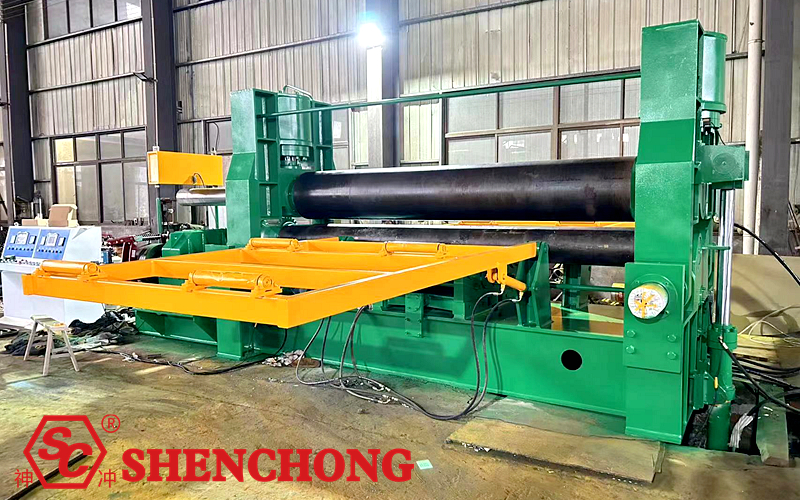
For heavy-duty equipment (40×3500mm), I highly recommend considering side support devices based on the actual workpiece conditions.
The functions of side support include:
- Preventing large cylinders from sagging
- Stabilizing steel plates
- Improving the rolling quality of large thin-walled cylinders
- Reducing operator assistance
- Improving safety
Some universal upper roller machines can be equipped with hydraulic side supports to support wide or thin plates, reducing sagging caused by the plate’s own weight.
7. Is top support needed?
If processing:
- Large diameter cylinders
- Thin-walled cylinders
- Large storage tanks
- Wind towers
- Long cylinders
Then, consider configuring a top support device.
Its function is to prevent the already rolled cylinder from:
- Elliptical deformation
- Sagging
- Deformation due to its own weight
Especially suitable for continuous production of large cylinders.
8. The biggest advantage of SC universal upper roller bending machine: reducing straight edges
Straight edges are a very important issue in cylinder manufacturing.
Assuming the steel plate is: 40mm × 3500mm
If the pre-bending at both ends is insufficient, noticeable straight areas may appear at both ends after rolling into a cylinder.
Subsequent steps required:
- Trimming
- Rounding
- Flame straightening
- Increasing machining allowance
All of these will increase costs.
One of the core values of the universal upper roller structure is its improved end pre-bending capability, thereby reducing the length of straight edges. This is what makes it more valuable than a typical symmetrical three-roll mill.
9. Suitable for processing which products?
1) Pressure Vessels
This is a very typical application.
For example:
- Gas storage tanks
- Pressure vessel cylinders
- Chemical tanks
- Steam equipment
- Heat exchange equipment
2) Petrochemical Equipment
Suitable for processing:
- Storage tanks
- Oil tanks
- Chemical towers
- Pipeline cylinders
- Large containers
3) Wind Power Equipment
Especially suitable for:
- Wind turbine towers
- Tower sections
- Large cylindrical structures
The wind power industry typically requires wider, thicker steel plates and stable roundness, therefore heavy-duty upper-roll universal plate rolling machines have a significant advantage.
4) Boiler Manufacturing
Can be used for:
- Boiler cylinders
- Pressure shells
- Boiler supporting structures
5) Shipbuilding
Used for:
- Hull curved panels
- Cylindrical structures
- Ship supporting components
6) Steel Structure Manufacturing
For example:
- Large steel cylinders
- Cylindrical structures
- Arc-shaped components
- Engineering machinery structural components
 English
  Spanish
  Portuguese
  Russian
  Arabic
  French
  Italian
  German
  Polish
  Thai
Thai  Vietnamese
  Lithuanian
  Czech
Czech  Korean
  Japanese
  Chinese